
Dan Dionisie
Head of Unit A3, DG JUST
European Commission
Rue Montoyer 59
1000 Bruxelles
9 May 2025
Dear Mr Dionisie,
Subject: Examples of obstacles to the exercise of shareholder rights
The International Corporate Governance Network (ICGN) appreciated the opportunity to meet with you on 4 February 2025 to discuss our Recommendations to the European Institutions on Shareholder Rights (October 2024).1
Led by investors responsible for more than US 90 trillion of assets under management, ICGN is a non-profit organisation that promotes high standards of corporate governance and investor stewardship. Our members are based in more than 40 countries, and include asset owners, asset managers and advisers.
Investors’ ability to act as responsible and effective stewards is reliant on them having rights and protections, such as the right to vote on major issues affecting the company, the right to participate in annual general meetings, the right to information, etc. Unfortunately, we observe some remaining barriers to the exercise of shareholder rights in the EU. These include legal and regulatory obstacles, lack of enforcement of existing rules, as well as operational obstacles. We encourage the European Commission to address these issues.
This is in line with the European Commission’s objectives of cutting red tape and simplifying rules. Addressing these obstacles would also be an important step towards the achievement of the Savings and Investment Union, the Sustainable Finance Agenda, and would help strengthen the attractiveness and competitiveness of Europe’s capital markets.
As agreed during our meeting, ICGN is sharing with you a list of examples of barriers to the exercise of shareholder rights in the EU, in Annex 1 to this letter. We hope that this input will be helpful, ahead of the revision of the Shareholder Rights Directive and/or Omnibus proposals.
Since our conversation, a Study on the Application of the Shareholder Rights Directives by the Centre for Strategic & Evaluation Services (CSES), Tetra Tech, EY and Oxford Research was released.2 We share some observations on this study in Annex 2.
Thank you again for the opportunity to share our perspective.
Yours faithfully,
Jen Sisson
Chief Executive Officer, ICGN
Annex 1 – Examples of obstacles to the exercise of shareholder rights in the EU3
| Issue/obstacle encountered | Example of EU/EEA Member State | Observations from ICGN members and implications for investors’ stewardship activities |
| Vote “cut-off” date is set too early (deadline by which investors must send their voting instructions to the custodian) | Poland, Germany, Finland, Denmark, Sweden, Austria, Portugal, Cyprus | In many EU markets, investors are asked by their custodians to cast their vote long before the annual general meeting (AGM) and shortly after having received the company’s proxy statements. This represents an obstacle to making informed voting decisions, which is an important aspect of investors’ fiduciary duty towards their clients and beneficiaries. For instance, in Poland, the ‘cut-off date’ is often 16 to 19 days before AGMs. In Germany, Finland, Denmark, Sweden, Austria, Portugal and Cyprus, it tends to be between 10 and 13 days before AGMs. In most EU Member States, the deadline is 7-8 days before AGMs. France and Spain stand out as positive examples, with a cut-off date much closer to the AGMs. A cut-off date set, for example, 4 days before the AGM gives investors sufficient time between receiving the company’s proxy statement and the cut-off date, allowing them to consider the latest available information to make an informed decision and to engage with the company on specific voting items if necessary. Note that in the United States, the cut-off date tends to be the day before the AGM. The Commission should encourage intermediaries in the voting chain to set the cut-off date closer to the meeting date. The Commission could publish guidance, with the support of a multi-stakeholder working group. |
| Companies’ meeting materials are released late | Italy, Greece | Currently, in some markets, shareholders and proxy advisers are afforded limited time to thoroughly analyse the relevant company documents ahead of general meetings, because these documents are released too late by the company. This is the case in Greece, for instance, but also in Italy, where materials are typically made available only 21 days prior to the AGM – an insufficient timeframe given the volume and complexity of the information to be reviewed. This challenge is made more burdensome by the concentration of AGMs within a short window each year. Investors also note that proxy research about companies listed in Italy and Greece tends to come in on average 13 days in advance of AGMs, which leaves little time before the cut-off date by which investors must submit their votes. On the contrary, proxy research about companies listed in the Netherlands is released early (around 27 days before the AGM), which is a positive example. The revised Shareholder Rights Directive should require that meeting materials be distributed well in advance of the shareholder meeting – for instance 30 to 40 days before – to enable shareholders to make informed voting decisions. |
| Short timeframe between receiving proxy research and the cut-off date to submit their vote | Poland, Finland | An investor highlighted that their voting data shows that they receive the least time to analyse voting matters related to companies in Poland and Finland. In 2024, they had on average 4.3 days to make a voting decision for companies listed in Poland, and 3.2 days for companies listed in Finland. This is an improvement from 2021, when they had only 1.7 days to analyse a vote in Poland, and 0.8 days in Finland. But still, they find that these slight improvements are insufficient and do not allow enough time for thorough vote analysis. In most EU Member States, investors have an average of 7-12 days for their analysis and voting decisions, with big variations across the EU. This could be addressed through a requirement that meeting materials be distributed well in advance. We also believe that the Commission should encourage intermediaries to set the cut-off date closer to the general meeting. (see sections above) |
| Information on board director nominees is shared too late | Poland | Some EU markets allow the disclosure of the board directors nominees to be a few days before the AGM, and therefore after institutional investors have cast their votes. In Poland, the 2021 Code of Best Practice for the Warsaw Stock Exchange (WSE) Listed Companies4 allows companies to disclose nominees for the supervisory board up to three days prior to the AGM, and therefore after institutional investors have cast their votes (as per the cut-off date, which is typically 16-19 days ahead of the AGM in Poland). Moreover, investors have encountered cases where companies fail to follow the 2021 Code and board candidates are nominated during the meeting. Investors rely on strong independent boards to provide strategic guidance, risk oversight, and effective monitoring of company management’s plans and performance. Voting on the election of directors is an important responsibility for investors. The European Commission should encourage Member States to remove any obstacle to voting on the election of directors. |
| Share blocking | Germany, Iceland, Luxembourg, Switzerland, | While share blocking is not permitted under the Shareholder Rights Directive II, investors still observe this practice, to an extent, in Iceland, Luxembourg, Germany and Switzerland. Investors are sometimes asked by intermediaries to hold their shares until after the AGM if they wish to vote. An intermediary might block the positions in order to organise their vote processing requirements. In Switzerland, certain shares must be re-registered into the name of the beneficial owner before a vote can be lodged at the meeting. The share position, while not formally being blocked, will not be able to be traded as the shares are in the name of the beneficial owner. Not being able to sell a stock (in case a meaningful event happens for instance) represents a risk that investors may not be willing or able to take. Therefore, they may choose not to vote. We encourage the Commission to ensure the enforcement of the ban on share blocking. |
| AGMs are organised very close to one another in the same market | Italy, France, Germany, and others | In many markets, all listed companies hold their AGMs in one short period of time. This common practice gives investors and their advisors little time for analysis. It can also make attendance challenging. As an example, in France, 5 companies out of CAC 40 are having their AGM on 24 April 2025. An investor explained that on the same day of 24 April, they will vote at 29 AGMs across Europe. |
| Burdensome power of attorney requirements5 | Austria, Bulgaria, Hungary, Cyprus, Latvia, Lithuania, Portugal, Romania, Slovenia,Sweden, | Investors observe burdensome “powers of attorney” (PoA) requirements in several EU countries to be able to vote. These often need to be submitted as hard-copy, legalised documents, with manual processing and physical submission. For instance, Bulgaria has the most onerous PoA requirements and a PoA must be completed per issuer In Sweden, multiple PoAs are required in case more than one company is holding a meeting the same day. These requirements create unnecessary administrative burden for investors. We recommend a ban on PoA requirements or at a minimum a substantial simplification and digitalization of the process. This is in line with the Commission’s priority to remove unnecessary and burdensome rules that act as a barrier to the integration of capital markets. |
| Manual requirements or presence requirements | Germany, Luxembourg, Sweden | In Germany and Luxembourg, investors have encountered the following issue: some companies require that ballots voted electronically also be completed manually with a shareholder registration. This creates unnecessary administrative burden and increases the risk that a vote cannot be cast. In Sweden, shareholders who wish to vote are required to be represented in person, which necessitates the appointment of a proxy representative. For some meetings, voting is done by show of hands. The revised Shareholder Rights Directive should ban these practices. |
| Obstacles to split-voting | France, Sweden, Norway, Hungary | Several EU markets do not allow split voting. Split voting or pass through voting allows asset managers to pass voting rights to a fund’s underlying clients. This enables asset managers to offer the possibility to their clients – for instance a pension fund – to select a voting policy that reflects their views. The Commission should identify and address barriers to split voting/pass through voting. |
| Fully virtual or ‘closed-doors’ AGMs | Denmark, Finland, Germany, Iceland, Sweden Italy (not virtual, but closed doors AGMs) | Many investors are concerned by decisions in some Member States to make the COVID-19 emergency measures of fully virtual AGMs or closed-doors AGMs permanent. This significantly limits the ability of shareholders, especially minority shareholders, to interact with boards and management, ask unmoderated questions, and make statements from the floor. We note that legislation in Germany and the Nordics allow fully virtual AGMs. In virtual AGMs, it is crucial to have strong safeguards to protect shareholder rights – which some of these markets have implemented. A company deciding to move to fully virtual AGMs should have shareholders’ approval; and investors will want to understand the reasons why a company chooses to conduct a virtual AGM (it should be for emergency situations). Moreover, shareholders must have the ability to ask questions, including follow-up questions from the floor to management in real time, without prior gatekeeping by management. These safeguards should be in regulation and there should be monitoring by the regulator to ensure their implementation. In Italy, the AGMs in “closed doors” format has become a permanent feature of Italian corporate governance, with the revision of the Legge Capitali in 2024. This means Italian companies can amend their articles of associations and hold their AGMs without investors’ presence. There is only a company-appointed representative attending on behalf of all investors. ICGN has written to the Italian government to share investors’ concerns.6 We welcome the Commission’s decision, announced on 7 May 2025, to call Italy to correctly transpose Shareholder Rights Directive on this matter7 ICGN strongly encourages companies to provide hybrid AGMs, to give investors the option of virtual or live participation. The European Commission could identify AGM best practices and develop guidance. |
| Lack of transparency on voting outcome | Sweden, Denmark, Finland, Portugal | In Sweden, Denmark and Finland, it is common practice for companies not to report the number of votes cast ‘For’, ‘Against’, or ‘Abstain’ on each resolution. This prevents investors from evaluating the outcome of the annual meeting, assessing areas of shareholder dissent and the company’s response thereto. This negatively impacts investors’ ability to set engagement priorities. The European Commission should require all companies to disclose full poll results shortly after the meeting – ‘For’, ‘Against’ and ‘Abstain’ votes, and % votes for each in the separate columns. This basic tabulated disclosure is lacking in Sweden, Denmark and Finland. Companies should also state the turnout and how abstentions are treated. Ideally, it would be useful to have a public register for all company meetings with exportable vote results in each market. |
| Multiple voting rights are allowed without time- based sunset clause | EU Directive allows it | ICGN supports the “one share, one vote” standard. Unequal voting rights (including loyalty shares) are problematic because they cause misalignment between control and economic interests, and dilute the voice and influence of minority shareholders. They may serve to entrench management and allow founders and controlling shareholders to monopolise the decision-making, potentially putting minority shareholder interests at risk. We ask that the Directive on multiple-vote share structures be modified to include a set of minimum mandatory safeguards in all EU Member States, most importantly a mandatory time-based sunset clause of 7 years or less. We would also encourage a limit on the ability to transfer such shares, a limit to the maximum voting ratio that can be applied, and ensuring that unequal voting rights cannot apply to certain material decisions. There should be mandatory class-by-class vote disclosure, whereby companies with multiple classes of shares are required to disclose vote tallies for each class. This gives visibility to both investors and to the boards and management of companies as to the nature of the preferences of both insider and independent shareholders. |
| Uncertainty on the treatment of shareholder proposals | France, Germany, the Netherlands, etc. | There is an overall lack of clarity in the EU around the legal possibility to file advisory-only shareholder proposals. For example, in 2022, a large German company refused to include a shareholder proposal on its agenda which asked for transparency regarding how the company’s lobbying activities aligned with its climate goals. The company argued that such proposal would interfere with the executive board’s authority. More recently in France, the board of a large listed company decided unilaterally not to include a shareholder proposal on the ballot. It was unclear which criteria were considered by the board when deciding to omit the proposal from the ballot. Advisory-only proposals allow shareholders to express their views and send a strong signal to board and management on material issues without mandating immediate action. The Commission should ensure that shareholders can file proposals (including the submission of resolutions for an advisory vote at the AGM on material topics). It could be beneficial to introduce a set of harmonised standards for the Single Market (on thresholds, nature, conditions, etc.). Among others, it would be helpful to have objective criteria, set at EU level, that companies must consider when deciding on whether to omit a proposal or include it in the ballot. |
| Obstacles to collaborative engagement | Germany | We note that, despite the European Securities and Markets Authority’s (ESMA) 2014 Statement Information on shareholder cooperation and acting in concert under the Takeover Bids Directive,8 collaborative engagement on material sustainability issues can still be perceived by national regulators as acting in concert, for instance in Germany. Investors need reassurance that they can engage jointly with companies on important governance matters, including material issues related to long-term corporate sustainability, in all EU Member States, without being perceived as acting in concert with other investors. The Commission could ask ESMA to review its 2014 Statement to make explicit reference to material sustainability-related issues, and extend it to include guidance regarding acting in concert under the Transparency Directive. It is also important to ensure that the guidance has sufficient legal weight to be uniformly implemented in all EU Member States. |
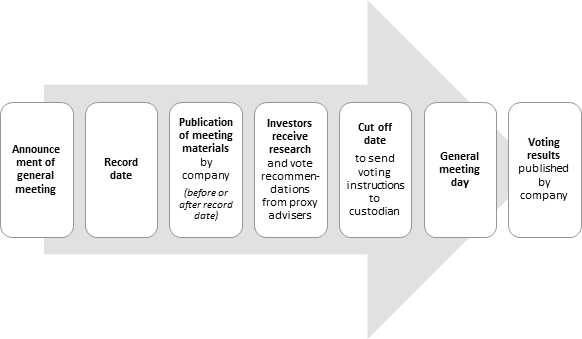
Illustration of key voting dates for institutional investors:
Annex 2 – Observations on the Study on the Application of the Shareholder Rights Directives
A Study on the Application of the Shareholder Rights Directives was commissioned by the European Commission.9 It was published recently by the Centre for Strategic & Evaluation Services (CSES), Tetra Tech, EY and Oxford Research.
ICGN welcomes the following observations made in the study:
- We agree that hybrid AGMs should become the norm and with the recommendation that the Commission should provide guidance on what qualifies as ‘meaningful participation’ in virtual/hybrid meetings. Highlighting best practices to ensure the protection of shareholders would be beneficial for companies, investors, and their advisers.
- The study highlights that PoA requirements are a prominent obstacle to exercising voting rights. It also notes that there is still a need for physical attendance and heavy legal documentation to be able to vote. We agree with these observations.
- The study shows that tight voting deadlines set by custodians/intermediaries can create an obstacle to informed voting decisions.
- We agree with the recommendation that publication of voting results should be closer to the meeting and details on votes cast per resolution should be provided.10
- Finally, we agree that confirmation of voting within a given time frame should be automatic and not by request.
However, we also want to highlight some areas where there might be misconceptions in the study, more specifically on the role of proxy advice and research providers in the voting process.
Investors make informed voting decisions based on myriad inputs, such as in-house voting policy, investment thesis, engagement with the company, as well as internal and external research. Exactly what these inputs are vary by manager and investment approach.
Proxy advisors provide very useful company-specific research and analysis which help investors make informed decisions. They also help investors in the voting execution, by making it possible for investors to vote across thousands of company meetings. However, there are some misconceptions on the influence of proxy advisors. It is important to remember that the investor remains the decision-maker. Proxy advisors don’t vote. Investors do.
A vast majority of institutional investors have their own voting guidelines, which are implemented by their proxy advisors through customised voting policies. Proxy advisors have specific agreement with each of their clients and act on the instructions of those clients.
Furthermore, proxy advisors’ benchmark policies reflect the voting preferences of their clients and are developed after regular and extensive client outreach. Proxy advisors regularly consult with their clients to understand what information and data points are useful to them and should therefore be included in their research reports. They also consult on the evolution of their own voting policy direction to reflect evolving clients’ views.
As a result, the market may observe a correlation between the vote recommendations by proxy advisors and significant votes against management at company AGMs. This correlation should not be confused with causation. If there is a causal link, it is rather that proxy advisors have been asked by their clients to flag certain issues through their vote recommendations.
The UK Financial Reporting Council (FRC) commissioned independent research to investigate the influence and impact of proxy advisors on FTSE 350 companies’ actions and investors’ voting decisions.11 The research found that “the nature and extent of this influence may be more nuanced and less clearcut than is believed to be the case by many companies, stakeholders and other commentators.”
Additionally, we would note that use of outsourced service providers can support quality client service and value for money, by reducing costs. Undue interference with the use of any relevant service providers for asset management firms, pension schemes, defined contribution pension providers and other investment product providers, risks adding costs to the end consumer, which may then negatively impact long-term returns.