
Sustainable Accounting Standards Board
1045 Sansome Street
Suite 450
San Francisco, California
94111
USA
Via email: comments@sasb.org
17 December 2020
Subject: (SASB) Bases for Conclusions & Invitation to Comment on Exposure Drafts
We are pleased to respond to the Sustainable Accounting Standards Board (SASB) consultation on proposed changes to the SASB conceptual framework and rules of procedure.
Led by investors responsible for assets under management in excess of US$54 trillion, ICGN is a leading authority on global standards of corporate governance and investor stewardship. Our membership is based in more than 45 countries and includes companies, advisors and other stakeholders. ICGN’s mission is to promote high standards of professionalism in governance for investors and companies alike in their mutual pursuit of long-term value creation contributing to sustainable economies world-wide.
ICGN offers an important investor perspective on corporate governance to help inform public policy development and the encouragement of good practices by capital market participants. Our policy work is conducted through five committees, including our Disclosure and Transparency Committee (DATC) which focuses on enhancing company communications through robust integrated reporting, quality audit and metrics. DATC members have worked to formulate this response and will remain available for additional consultation if desired.
We have followed SASB’s impressive progress and have supported its development from the beginning when SASB primarily focused on setting sustainability standards for regulatory reporting in the U.S. We congratulate SASB on the positive steps forward it has taken, including the recent announcement of SASB’s intention to merge with the International Integrated Reporting Council (IRRC), which is an important development in the needed consolidation of sustainability data and reporting frameworks globally. ICGN will continue to follow and encourage SASB’s progress as it evolves to be part of the new Value Reporting Foundation.
As requested, below, we have responded to certain questions posed in the consultation with the intent of supporting SASB in its development as a global standard setter.
- Do you believe the concepts described in the Conceptual Framework exposure draft are appropriate for a global standard-setting organization? Are there concepts or principles that warrant discussion in—or removal from—the Conceptual Framework to help the Standards Board more effectively develop standards that have global applicability?
We note that the changes made to the August 28, 2020 version of the Conceptual Framework and Rules of Procedure, as compared to the February 2017 versions of the same documents, better align SASB with global standard setting rather than one focused on U.S. only. This progress is encouraging. At the same time, we believe that building a greater global identity will remain an ongoing challenge. For example, one of our European members observed that the SASB exam’s focus remains largely U.S. focused. We recognise the significant challenge in evolving from a standard that was developed for U.S.-based regulatory reporting and stepping into a global environment that often provides more flexibility for companies in how and where they disclose their ESG performance. By employing a rules-based approach which applies line-item disclosure on specific metrics, SASB’s approach is more prescriptive and less principles-based, and this may contribute to perceptions that the Conceptual Framework continues to lean towards a U.S. model.
Next, we believe the drafting of the Conceptual Framework’s mission may invite some confusion. The SASB Conceptual Framework opens by highlighting two key components (See Figure 1.):
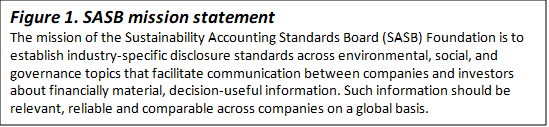
We see that the mission of the Sustainability Accounting Standards Board (SASB) Foundation is to both establish industry industry-specific disclosure standards environmental, social, and governance topics and facilitate effective communication between companies and investors on these topics. This formulation risks giving the impression of internal inconsistency and may not be in line with what SASB actually does. We note that this description seems to place governance on an equal footing with environmental and social issues, however the Conceptual Framework itself actually qualifies the boundaries of SASB’s work on governance. We believe that SASB could articulate more clearly in its mission statement, and the role that corporate governance plays in its standards, particularly with regard to financial materiality and decision usefulness.
- Should SASB describe its approach to governance in the Conceptual Framework? Is SASB’s approach to governance, as described above, sufficiently clear?
Yes, SASB should describe its approach to governance in the Conceptual Framework. As currently described, SASB’s approach is not entirely clear. As noted above, SASB includes governance in its mission without qualification and this pattern continues in most descriptions of SASB’s work. We believe there may be scope for greater transparency regarding what aspects of sustainability SASB places greatest emphasis upon (e.g., environmental and social factors relative to corporate governance), and this should flow from the mission and throughout the Conceptual Framework. In describing its approach to governance in the Conceptual Framework SASB may want to draw from how this is presented in the Exposure Draft.
- Are all aspects of the proposed definition of financial materiality clear and understandable? Does the definition accurately reflect SASB’s mission to facilitate communication between companies and investors about financially material, decision-useful sustainability information?
With its industry focus SASB takes a distinctive approach to determining materiality relative to other “non-financial” reporting standards. SASB determines what is material by topic within an industry and then links this to a metric representing that topic to be disclosed by an issuer. This creates the concern that issuers may not undertake their own materiality assessments and will instead just report on SASB metrics with limited further reflection or assessment of the potential or financial materiality. In other global reporting frameworks, the issuer makes the materiality assessment. This can create discrepancies in how materiality is determined under different standards.
We also observe that the SASB approach does not appear to address the issue of double materiality that is gaining momentum outside of the U.S.—particularly in the European Union. The SASB approach focuses on how sustainability and environmental, social and governance (ESG) factors affect the company itself. But it would not appear to directly address how the company itself may impact stakeholders and society more broadly. While this may be simply a matter of how SASB’s Framework is fundamentally constructed, the global debate relating to double or “dynamic” materiality will continue to make materiality determinisations a challenging issue for SASB and other sustainability standard setters. Consistent with its ambition as a global standard setter, we encourage SASB to better explain its approach to materiality to address the needs and concerns of users and reporters in other jurisdictions outside the U.S.
Finally, the definition of materiality is limited to “investment or lending decisions” which we believe is too narrow for the broad range of financial issues that draw from sustainability reporting. For example, for investors to fulfil their fiduciary duty as stewards it is important not only to think of investment or lending decisions, but also how sustainability reporting can guide investor engagement and the exercise of voting rights. There may be scope for greater thought about this stewardship dimension.
- Are the characteristics of topic and metric selection (as framed and defined in the exposure draft) supportive in establishing standards that produce financially material, decision-useful, and cost-effective information (i.e., SASB’s three core objectives)? Are the definitions of the characteristics sufficiently clear? Are any characteristics that may be supportive of the objectives of the Standards missing, and therefore should be added? Are any characteristics redundant or misaligned with these objectives, and therefore should be removed?
As noted earlier, SASB uses a distinctive, industry focused process in determining materiality. This approach has many merits. At the same time, however, it may not always address what investors are looking at globally, including the issue of double materiality discussed earlier. These characteristics do not always lend themselves to many of the topics normally considered by investors focused on sustainability, including externalities or distributional issues. SASB’s approach seeks to link metrics to topics intended to produce a financially material disclosure. Yet there is always the real chance that a specific metric identified may not always represent a financially material issue.
With regard to SASB’s materiality metric identification we welcome the new language in the General Issues Categories saying that SASB will identify “industry-agnostic and cross-cutting themes that allow comparisons across sectors/industries.” The lack of such metrics has been a key drawback to SASB’s industry-based approach, which has left investors without the tools they need to compare companies on common issues such as corporate political spending disclosure and human capital. We realise that SASB is considering whether to treat human capital as a cross-cutting issue in its current project on the topic and welcome the addition of this language in the SASB Human Capital Bulletin dated November 23. We also were pleased to read in Kelli Okuji Wilson’s blog of September 28 that looking at materiality issues across all industries has prompted SASB to realize that diversity is likely to be material across the board– and not just to the 13 industries in which the industry-specific approach found it to be. We believe the general principles should include more explanation about how SASB plans to apply this new approach in the future.
In this context we would argue that human rights is another factor that should be considered across all industries. We believe this is an important sustainability issue and note that the proposed European Union sustainable corporate governance initiative includes a proposal to require due diligence with the UN Guiding Principles on Business and Human Rights– a requirement that recently was endorsed by UN Global Compact. In addition, the UN Principles of Responsible Investment has said that it will require signatories to report on human rights assessments.
As it stands now, SASB’s draft description of its General Issues Categories does not provide sufficient detail about how it will handle such cross-cutting issues as they emerge. The same holds true for the issue of racial discrimination, which became a material issue virtually overnight after the killing of George Floyd prompted companies and investors in the U.S., the U.K. and several European markets to launch new initiatives on the topic.
- When read alongside the Rules of Procedure exposure draft, are there important aspects of SASB’s approach to standard-setting that are missing from the Conceptual Framework exposure draft? Are there any material inconsistencies between the Conceptual Framework and Rules of Procedure exposure drafts?
There are drafting points in the Rules of Procedure which reflect the same issue that we have already commented on regarding the SASB mission and the relative weighing of environmental, social and governance considerations.
- Please share any additional comments, concerns, or questions regarding the Conceptual Framework exposure draft.
We would like to thank you for raising these important questions. Our comments are made in good spirit — and in support of SASB’s long-term success as a global standard setter.
- Does the Rules of Procedure exposure draft provide a clear description of the Standards Board’s operating procedures? Are there any areas that should be further clarified?
The stated process for amending standards suggests that it may be substantially difficult to change and or modify any existing SASB standards. This is a concern given that most of the existing standards were developed specifically for U.S. regulatory disclosure. The Rules of Procedure could potentially inhibit the pace of SASB’s transition to a globally-recognised standard setter. In our experience, investment practitioners, as opposed to heads of investor organisations, have noted this issue as problematic.
- Does the exposure draft clearly explain the activities that the Standards Board and technical staff engage in to determine when and if standard-setting is necessary? Are these activities consistent with the mission of SASB and the objectives of the SASB Standards? Are there other activities that should be pursued to monitor the relevant industries and issues?
Yes, the exposure draft explains the activities. However, the exposure draft could more fully address what SASB will do to reinforce its global leadership, given its U.S. origins and focus. As noted earlier, relative to SASB’s mission dimension of fostering communication between investors and companies, this communication could suffer if companies are required to communicate on certain topics and metrics determined by SASB to be financially material rather than an issuer’s assessment of what may be financially material.
- Are the ways in which stakeholders can participate in SASB’s due process for standard-setting activities clear? Is it sufficiently clear how such participation may inform standard-setting outcomes? Are there other methods the Standards Board and/or technical staff should pursue to obtain market input on the Standards?
On the surface the process can appear quite cumbersome, and potentially discouraging to those who may wish to particulate. As currently drafted, eight steps are required over an extended period of time. This could have the effect of locking in the existing standards for quite some time even if there is a nearer term need to modify them.
- Is SASB’s governance structure sufficiently and clearly articulated in the document and in a way that appropriately contextualizes subsequent content in the document? Is the independence of the Standards Board clear? Is the oversight role of the Foundation Board of Directors clear?
We believe there is scope for greater clarity regarding SASB’s independence and how the Foundation Board of Directors will provide appropriate oversight.
- When read alongside the Conceptual Framework exposure draft, are there important aspects of policies and practices followed by the Standards Board that are missing from the Rules of Procedure exposure draft?
As noted above, there should be clearer lines for stakeholder participation and how the mission balances environmental, social and governance factors.
- Please share any additional comments, concerns, or questions regarding the Rules of Procedure exposure draft.
As noted earlier, ICGN congratulates SASB on its successes and emergence as a global standards setter and we look forward to supporting SASB during this important period when global sustainability reporting standards and frameworks are converging. This will be a dynamic process, but we believe that SASB and its capabilities will feature permanently in how these standards come together.
We hope that our input is helpful, and we look forward to engaging with you in this or other matters where we could provide meaningful input. Should you wish to discuss our comments further, please contact me or George Dallas, ICGN’s Policy Director, by email at george.dallas@icgn.org.
Yours faithfully,
Kerrie Waring,
Chief Executive Officer, ICGN
Copy: James Andrus, Co- Chair, ICGN Disclosure and Transparency Committee: James.Andrus@calpers.ca.gov