Mr. Kenji Okamura
Director-General, International Bureau
Ministry of Finance
3-1-1 Kasumigaseki, Chiyoda-ku
Tokyo 100-8940, Japan
By post and email: yukihiro.takahashi@mof.go.jp
cc: Mr. Kenichi Habu, Head, Legal Office, Ministry of Finance
Mr. Hideaki Imamura, Director, Research Division, Ministry of Finance
cc: Ministry of Economy Trade and Industry
Financial Services Agency
Japan Exchange Group
20 February 2020
Dear Mr Okamura,
Re: Amendment Bill of the Foreign Exchange and Foreign Trade Act
Following our letter of 25 October, 20191, we are writing to reiterate our concerns related to the proposed amendments to the Foreign Exchange and Foreign Trade Act (FEFTA).
The International Corporate Governance Network (ICGN) is a global organization led by institutional investors responsible for assets under management in excess of US$34 trillion. Our mission is to promote effective standards of corporate governance and investor stewardship to advance efficient markets and sustainable economies worldwide.
Japan is a very important market for ICGN Members, many of whom have significant investment holdings in Japanese companies. As such, ICGN has been actively engaged with authorities such as the Financial Services Agency and the Ministry for Economic Trade and Industry to help encourage many of the positive reforms to Japanese corporate governance and investor stewardship practices in recent years. This policy work supports our domestic Japanese investor members, but also represents the voice of overseas investors who hold over 30% of the Tokyo Stock Exchange market capitalisation.
This letter builds further from ICGN’s 12 December 2019 webinar which focused specifically on the proposed amendments to FEFTA and was kindly presented by Mr. Hideaki Imamura of the Ministry of Finance (MoF). We very much appreciate the willingness of the MoF to engage with investors on FEFTA and we also appreciate the government’s sensitivities relating to national security and the ownership of Japanese companies. However, we remain concerned that the proposed amendments will have a disproportionate effect of creating unnecessary limitations and complications for investors in ways that will impact negatively Japanese corporate governance, investor stewardship and the attractiveness of Japanese financial markets.
As the details of the FEFTA amendments are reviewed by the MoF ahead of the planned implementation in May 2020 we would like to articulate specific points relating to investor concerns and expectations. Firstly, we believe there is scope for greater clarity about the companies or sectors that be affected by these amendments. We understand that the industrial sectors subject to prior approval will be those which are judged to bear material risks to the national security of Japan. However, it is our expectation that any identified sectors should be strictly, and clearly, linked to questions of national security—and should not be decided for other purposes, such as the possible desire to more generally limit overseas shareholder activism in Japan.
We also understand that foreign investors will be exempted from having to file prior notifications to the MoF if certain conditions are met. However, many of ICGN Members are pension funds and sovereign wealth funds which conduct investment management either themselves or through their investment management subsidiaries. We understand that they will be required to be reviewed by MoF individually whether they are subject to prior notice exemptions given their corporate governance structure. In this case ICGN Members hope and expect that these criteria will be rational, fair and clearly disclosed.
As for the three conditions to be required to for prior notice exemption, we are not aware of such requirements by other major developed countries in their internal direct investment regulations. We are deeply concerned that these requirements would potentially decrease appetite of overseas investors to invest in Japan.
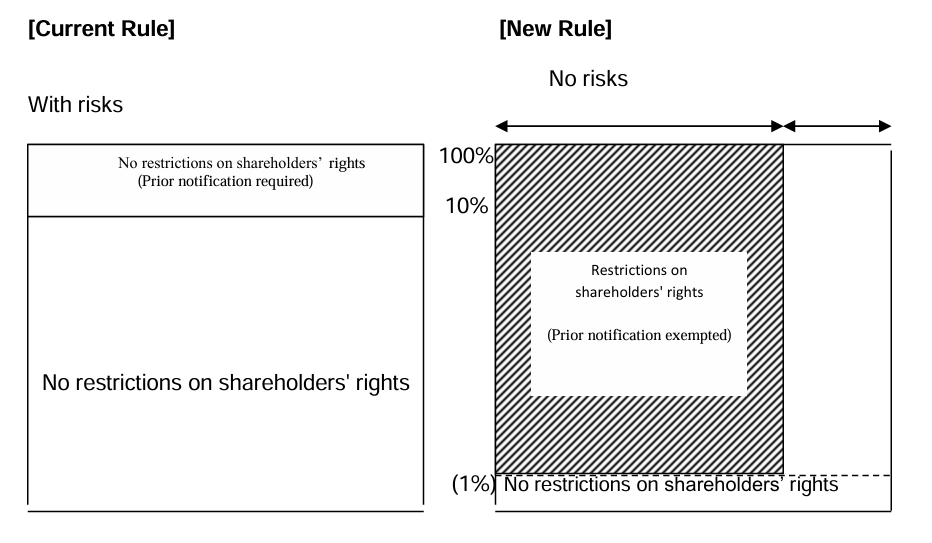
The first condition would prevent overseas investors from appointing related candidates to serve on Japanese boards and thereby oversee the executive officers of investee companies. This would have the effect of limiting a fundamental right of shareholders guaranteed by the Companies Act in Japan. Without appropriate oversight by shareholders, this limitation can easily lead to reduced discipline of corporate management of Japanese companies and would deprive investors of opportunities for stewardship, particularly at times when investor input is needed. The table in the Appendix below was presented in ICGN’s December webinar and represents the large extent of limitations to shareholders’ rights under the new arrangement. We also note that definition of ‘closely related persons’ is not clear and should be rational and transparent to all parties.
The second condition prevents investors from proposing the sale, transfer or disposition of business units at shareholders’ meetings. This also compromises fundamental rights of shareholders guaranteed by the Companies Act in Japan. It is a common and legitimate practice for investors to discuss or suggest the potential transfer or disposal of inefficient business of investee companies in their stewardship activities and at shareholders’ meetings in order to promote sustainable medium-to long-term corporate value. This should not be constrained.
Finally, we would like to express concern about the significant drop in the proposed shareholding threshold for the application of the investor notification requirements from 10% to 1%. We observe that a 1% threshold is very low in an international context, particularly given the current lack of clarity as to which companies/sectors are to be affected by the proposed amendments. It is critically important for investors to know in advance the extent to which this new 1% threshold would apply. If the scope of designated sectors is clearly linked to national security and limited to weapons, nuclear facilities and possibly certain electricity and telecommunication services, and is applied to a very limited number of listed companies, then we appreciate that there may be a logic in a 1% threshold in those clear cases of national security.
However, if the scope of companies and sectors to be affected is broader than this, and not clearly linked to national security, then we would interpret the intent of this lower threshold negatively, as an implicit attempt to limit overseas shareholder activism more generally in Japan. In such a scenario we would advocate that there should be no change from the status quo and that the 10% threshold should remain unchanged. To resolve this question, it is imperative for investors to have an exhaustive list of companies that would come under the purview of this legislation. Simply citing typical examples is insufficient here.
We sincerely hope that remaining amendments to the Act will take into considerations these serious concerns of Japan’s important overseas investor base. The stakes are high and ICGN encourages the MoF not to jeopardize the positive corporate governance and stewardship reforms led by Prime Minister Shinzo Abe in recent years.
We hope these comments are useful in your deliberations. If you would like to follow up with us with questions or comments, please contact me, ICGN’s Policy Director, George Dallas (george.dallas@icgn.org) or ICGN’s Japan Advisor, Amane Fujimoto (amane.fujimoto@icgn.org).
Yours faithfully,
Kerrie Waring
Chief Executive Officer
Appendix: Scope of companies subject to restrictions on shareholders’ rights