
Elizabeth King
Chief Regulatory Officer
Intercontinental Exchange Inc.
11 Wall Street
New York, NY 10005
USA
7 November 2018
By email: Elizabeth.King@theice.com
Re: Dual Class Share Structures
Dear Ms. King,
Led by investors responsible for assets under management in excess of US$34 trillion, ICGN is a leading authority on global standards of corporate governance and investor stewardship. Our membership is based in more than 45 countries and includes companies, advisors and other stakeholders. ICGN’s mission is to promote high standards of professionalism in governance for investors and companies alike in their mutual pursuit of long-term value creation contributing to sustainable economies world-wide.
We are writing to express our support by a petition put forward by the Council of Institutional Investors (CII) to the New York Stock Exchange (NYSE) and NASDAQ with regard to dual class share offerings: to require to a time-based sunset clause for dual class shares to revert to a traditional one-share/one-vote structure no more than seven years after a company’s IPO date. We think this is a sensible, if not moderate, proposal that can allow companies to experience the potential benefits of protection from market forces during the early stages of their public listing—but also to ensure that the discipline and accountability that comes with one-share/one-vote is re-established as the company matures and its governance requirements evolve.
We believe the life cycle of the company is often given insufficient attention in terms of corporate governance standards and structures; what may be appropriate for a young IPO may not be appropriate for a more well-established and mature company. In this context we believe the CII petition represents a fair way to approach this issue. To be clear, ICGN policy embraces one-share/one-vote at all companies, including new IPOs. But we think a rule for time-based sunsets is a good path forward on this issue.
We present below our position on dual class shares that has developed through recent regulatory changes in differing global markets to allow for dual class listings. In this context we have expressed concerns about a regulatory “race to the bottom” by stock exchanges that appear to be competing with one another for new listings by watering down investor protections and rights. You will see that we prefer not to have dual class listed shares at all, but we do recognise the reality that this remains an attractive option for certain founding shareholders who wish to enjoy the private benefits of control, even when their economic stake may be a minority. However, where such structures exist we strongly believe any such benefits should be short lived, to hold, at least over the medium to long term, companies and their controlling shareholders accountable to other minority shareholders.
Dual class share structures: ICGN position
ICGN has regularly commented about differential rights in regulatory consultations around the world, and has also expressed its views in Viewpoint reports in 2017.1 Our message is consistent: ICGN and its members are fundamentally opposed to differential ownership rights, dual class share structures and the separation of economic ownership and voting control. We believe these structures are fundamentally flawed and carry significant governance risks for minority shareholders by diluting minority shareholder protections, management entrenchment and limited accountability. In extremis such structures create opportunities for expropriation, with controlling shareholder gaining private benefits of control at the expense of minority shareholders.
We are concerned in particular that we are witnessing a “race to the bottom” by major global stock exchanges seeking to attract listings by watering down governance safeguards. In 2017, in an ICGN membership poll, 84% of ICGN members disapproved of differential voting right structures and 67% believed that differential voting structures would impact negatively stock valuations.
We also cite a wide body of academic evidence which suggests that minority shareholders may be the net losers in differential ownership arrangements:
- A recent research literature review of differential ownership by Stanford University academics Larcker and Tayan concludes “the evidence suggests that companies with dual-class structures tend to have lower governance quality”.2
- In an empirical study of dual class structures in the United States, the study’s authors (Gompers, Ischii and Metrick of Harvard, Stanford and Yale, respectively) concluded “we find that firm value is positively associated with insiders’ cash-flow rights, negatively associated with insiders’ voting rights, and negatively associated with the wedge between the two.” The authors go on to say that “a majority owner of a private company can rationally choose to sacrifice some firm value in order to maintain private benefits of control.” That may be well and good for the controlling owner. But it also suggests that these private benefits come at a cost to minority investors.3
- A study of dual class share structures by Harvard Law School academics (Bebchuk and Kastiel) outlines the risks of entrenchment, self-dealing and perverse incentives that come with dual class shares, noting that there is an “untenable” case for perpetual dual class shares. They state that “as time passes the potential costs of a dual class structure ten to increase and the benefits tend to erode.” The authors propose a requirement for sunset provisions in cases where such structures exist.4
- Robert Jackson, a former Columbia Law School Professor, and currently a Commissioner at the US Securities and Exchange commission also recently articulated similar reservations about dual class share structures. Like Bebchuk and Kastiel he is not an advocate of dual class shares, and also supports the use of sunset provisions in cases where they exist. His own research suggests that if there is an advantage to dual class structures, such structures should not be permanent as they can lead to value deterioration over time.5 The following graph makes this point clear:
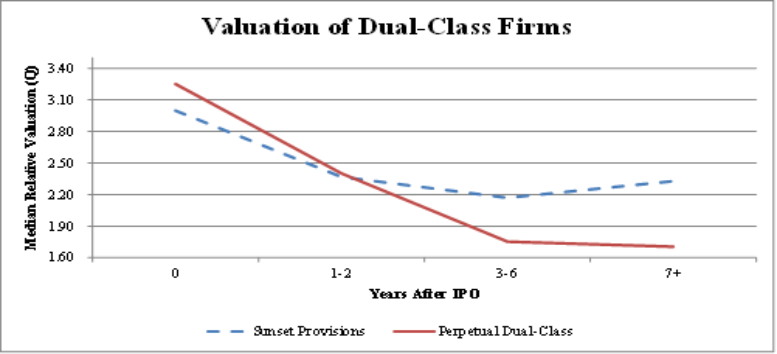
Source: Robert Jackson, US Securities and Exchange Commission, 2018
- A 2017 study of dual-class company performance found that even at innovative companies where unequal voting structures correlate to a value premium at the time of the IPO, that premium dissipates within six to nine years before turning negative.6
- A more recent 2018 study found that dual class structures correlate with more innovation and value creation in the period shortly after an IPO, but within six to 10 years, the costs of the unequal voting structures outweigh the benefits. The study’s authors conclude, “Our findings lend credence to the recent call from shareholder advocacy groups that if dual class structures should be allowed at all, they should face rigorous sunset provisions and be eliminated in a certain period post-IPO.”7
From this body of research we believe there are strong theoretical and empirical foundations that demonstrate the risks that dual class shares bring to minority investors. Though much of this research was based in the US, we believe it also has relevance in other markets globally, including Belgium. While the risks of dual class structures can ultimately be priced into a company’s valuation we believe the most sensible starting point is simply to avoid the introduction of dual class share regimes in the first place. Otherwise we believe there is a slippery slope to unintended consequences, even with the best of intentions.
Conclusion
ICGN and the vast majority of its investor members are concerned about the rise in dual class listings, which we see as a long term threat to investor stewardship and also to a company’s own sustainable value creation. In this vein we encourage you to adopt this CII proposal, and believe doing so would be an important step forward in enhancing investor trust in stock exchanges, given the critical role they play as gatekeepers to the capital markets for issuers.
We hope these comments are helpful with regard to your deliberations on these matters. Please contact ICGN Policy Director George Dallas if you would like to discuss this in further detail: george.dallas@icgn.org.
Yours sincerely,
Kerrie Waring
Chief Executive Officer, ICGN
Copies:
Bram Hendriks, Co-Chairman, ICGN Shareholder Rights Committee: BHendriks@ktmc.com
Eugenia Unanyants-Jackson, Co-Chairman, ICGN Shareholder Rights Committee: Eugenia.Jackson@AllianzGI.com