
ICGN Viewpoint
The Board of Directors & Climate Change
15 July 2020
Introduction
The Covid-19 health emergency has plunged the world into unprecedented crisis. It has also forced business leaders, policy makers and investors to confront the great fragility of our global health and economic systems, and shone a spotlight on the vulnerabilities that have built up over decades in our social safety net. Amidst extreme hardship, policy errors, squabbling and finger-pointing, what stands out is the extraordinary ability that most ordinary people have shown to pull together and radically change their behaviour when faced with alternative that does not bear thinking.
The crisis has understandably displaced attention from other priorities, including climate change, even prompting some to seize this opportunity to try to sideline them altogether. But the threat posed by climate change will not take a back seat to even a global pandemic: even as we need all hands on deck to focus on immediate survival, there is a growing movement led by policy and business leaders to remind us that the post-Covid-19 rebuild will need to incorporate a ‘Build Back Better’ strategy featuring a clear roadmap to net-zero by 2050.
Until recently, the single-greatest obstacle to embarking on a sufficiently ambitious climate transition strategy was cost: investing one or two percent of global GDP to avoid value destruction worth ten times that or more over several decades seemed an impossible ask. But now that fiscal discipline has suddenly become a luxury from another era, and trillions of dollars have been mustered to cushion the blow caused by the global shutdown, funding the climate transition may not seem quite so extravagant – particularly if we can kill two birds with one stone with a green rebuild. Canada, New Zealand and critically the EU have gone on record as stating that the reconstruction will not compromise on their net-zero goals, while large investors including BlackRock have reiterated their commitment to pursuing sustainable investment practices.
Pre-Covid 19, both investors and boards had been increasingly turning their attention to how leadership in the boardroom, and specifically engagement by non-executive directors (NEDs), could serve as a powerful agent for change in the way that companies reimagine their business in a net-zero world. In this new Covid era, the discussion continues, albeit infused with a completely different awareness of how small and vulnerable we all are in the face of these twin systemic challenges.
A fast-changing context: Attention to climate change has been skyrocketing
It cannot have escaped anyone’s notice, not even the most determined ostriches in our midst, that public attention to climate change has skyrocketed of late. The Fridays For Future movement; the Net-Zero by 2050 target of the European Green Deal ; the cascade of pledges by pension funds, insurance companies and now large asset managers, who have seemingly borrowed the once radical rhetoric of their smaller ESG-conscious colleagues; and most recently growing list of major banks eschewing coal and Arctic drilling. Meanwhile the central banks of England, France and the Eurozone, led by Governors Mark Carney, François Villeroy de Galhau and Christine Lagarde, have sounded the alarm over the threat posed by climate change to global systemic financial stability. They have been followed by 55 fellow central banks through the Network for the Greening of the Financial System, which is now exploring how to introduce consistent global norms for integrating climate factors into prudential regulatory frameworks.
For banks and insurers, this presents a new set of risk management challenges, prompting them to revisit their stress-testing models and scenario-building methodologies. For the non-financial companies who rely on the banking and insurance system to run their businesses day to day, this adds a whole new dimension to treasury and enterprise risk management.
But for the non-executive directors of all of these companies, whether financial, industrial or otherwise, this sudden surge in the importance of climate change presents a set of brand-new challenges for which few are properly equipped.
The state of boards today
For all the rhetoric about diversity, non-executive board directors tend to have one overwhelming trait in common: they are by and large intelligent, accomplished professionals who made their way to the pinnacle of their career in a period when climate change, and sustainability more generally, were fringe issues at best. To the extent they may have developed a sensibility around the issue – and here the picture is often mixed – it is often borne of a personal “extra-curricular” interest in the subject, rather than hard professional expertise of how it ought to be integrated into routine board processes, let alone strategic decision-making.
In practice, this means that despite the rising demands of investors regarding board governance of climate change, few boards can claim to be approaching the subject with anything like the rigour and professionalism that they do other core board functions, whether succession planning, audit, risk or strategy. And yet, in industries such as energy, automotive, steel, agri-food, aviation, not to mention banking, insurance and many others, where few would now claim the issue is “fringe”, climate change features rarely in the skill set of existing directors, nor is it typically specified for new board recruits or prioritised for board training.
This is not to say that the issue is neglected: in a substantial and ever-growing number of companies, especially in highly climate-exposed companies, there is a wealth of management talent and experience. But even in these more climate-savvy companies, the topic is typically “owned” by management, and often lies outside the NEDs’ comfort zone; as such, many directors are quick to downplay it on the grounds that “management’s got this one”. Would they say the same about the audit? About strategy or risk management?
This needs to change: for an issue of the existential importance of climate change, the board must play its rightful part in fully understanding and driving the company’s climate transition strategy. It must bring informed external perspectives, constructive challenge, rigorous oversight – but, equally, strong support when boldness and risk-taking are needed to steer a company through short-term pressures and keep an eye firmly focused on the long term.
The TCFD: A focus on governance … and the “D”
When boards begin their “journey” on climate change, they typically start with compliance, e.g. if in the EU, by signing off on an annual report in line with their home country’s enactment of the EU Non-Financial Reporting Directive. Beyond minimum compliance, the next move is often to embrace the Task Force on Climate-related Financial Disclosure (TCFD). Thanks to the widespread backing of the TCFD framework by nearly 500 investment institutions in key markets in Europe, Japan and North America1, and strong indications that it will move from soft law to hard law in the EU and U.K. , over 900 mostly larger companies have built their reporting around the TCFD’s simple focus on four key areas: Governance, Strategy, Risk Management, and Metrics and Targets.
To date, results have, perhaps understandably, been heavily skewed towards the D of Disclosure, i.e. extensive detail surrounding governance processes such as which board committees cover climate, the frequency and duration of meetings on climate, the hours of board training on climate, or the existence of climate-related targets. By contrast, aside from a small but now growing number of notable exceptions, comparatively little has so far been revealed about the substantive actions that companies have taken to transform their business models in order to re-position themselves for resilience and commercial success in a zero-carbon world.
And yet governance has a purpose beyond compliance with disclosure standards, and as such the TCFD’s ultimate purpose is clearly to spur action and ideally outcomes, not merely transparency, by shining a spotlight on what companies are doing and rightly holding the board accountable for ensuring the right actions are taken. The TCFD therefore ably frames the challenge but stops short of laying out the how-to manual for addressing it.
What should boards do?
With the TCFD’s explicit reference to Governance as one of the four core pillars of good practice, echoed by warnings from BlackRock’s Larry Fink and others that board directors will now be held accountable for their companies’ climate strategies, the spotlight has rightly shifted to the boardroom. But what does this mean, in practice?
The key challenge is that even for directors with a strong grounding in the science and macroeconomics of climate change, there is no ready how-to guide for how to weave together climate change with Enterprise Risk Management, Audit, Remuneration, capital expenditure modelling, and many other aspects of routine board activity. In fact, just about every board function has a relevant climate dimension, but the mechanisms of this are poorly understood. Instead, the board may receive an annual or semi-annual update on the company’s climate policies, including a few metrics on annual emissions reductions and targets. The more ambitious companies may lay on a specialised induction session to bring directors up to speed on what climate change is and why it matters.
But then what happens? For those NEDs fortunate to have access to such sessions, they often emerge from the climate training genuinely worried about what they now realise they do not know. The challenge, however, is that outside climate experts aren’t able to answer the “so now what?” question, i.e. how to interpret generic information about climate change and apply it to their role as stewards of the company. It is left up to the NEDs to work out what should change in their board priorities, processes and information flows; what questions they should be asking; and how to make sense of the answers. The cultural dimension is all-important: where directors sense their new and awkward questions are welcome – which means a receptive CEO and Chairman – they may press the point. Where not, putting the topic on the table can be risky: fellow directors may go strangely quiet, leaving them to play the part of “the difficult one” who is not a team player and brings “a political agenda” to the meeting. Reading the room is arguably as challenging as mastering the subject of climate change itself.
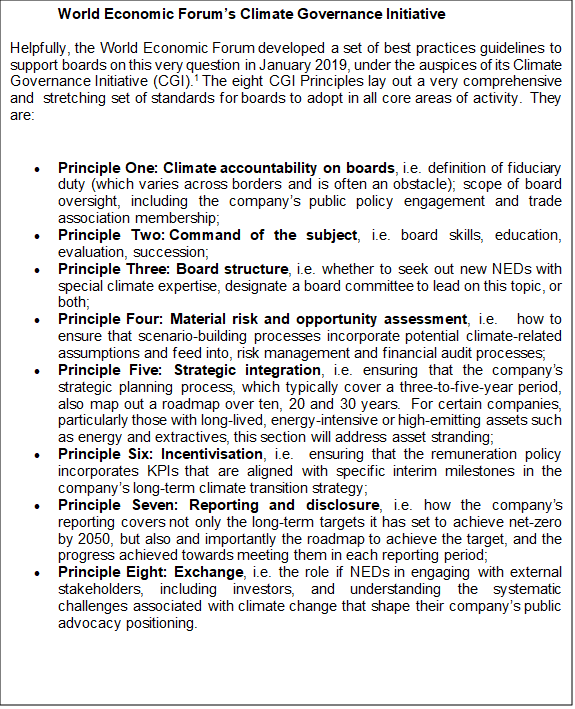
What does this mean in practice for boards?
There is always the risk that a paper of this nature by the World Economic Forum is politely received but of little practical impact. But since formally launching these Principles in early 2019, and indeed beginning well before, several dozen non-executive directors came together in Italy, Malaysia, France the U.K. and Canada to establish local “Chapters” that allow NEDs to meet and exchange with each other, as well as interact with outside experts and access formal training. This requires deep expertise, which is being accessed thanks to high-quality support from professional service firms, think tanks and others to deliver a completely new body of interdisciplinary knowledge that is tailored to the needs and specific oversight role of non-executive directors.
One key stakeholder group in this ecosystem is of course the investor community: directors lose much sleep worrying that investors will desert the company if it does either too little or too much in this area – and the fast-changing pace at which investor expectations have been changing makes this concern greater than ever.
What should investors do?
Investors should increasingly integrate climate considerations into stewardship activities, including company monitoring, voting and engagement. This can include assessing the company’s climate risks and board oversight of these risks; voting with regard to director nominations, executive pay or climate specific resolutions; or engaging directly with company executive management and non-executive directors. In particular, investors should seek to identify opportunities for collaborative engagement to leverage the voice of minority investors and exert influence, where required. As with any topic on which investors engage with companies and boards, ICGN urges investors to do their homework prior to the meeting in order to gain a detailed understanding of the company’s particular circumstances, and thereby tailor their questions appropriately.
Investors have raised the bar on boards, and rightly so: it is the directors’ job as stewards of the company to see to it that all functions across the company are fully aware of the implications of climate change for their company’s business model over the long term, and therefore what that means for the decisions that must be taken today, next year and in the next five, ten and twenty years.
Investors have an opportunity to ask well-informed questions that really get at the heart of how boards are approaching this issue, including:
Mandate and oversight
- What lessons, if any, has the Board drawn from the current Covid-19 crisis that may have implications for the way it addresses climate change?
- How does the Board define its oversight mandate and role in respect of the company’s climate transition strategy?
- How does the Board organise itself, in terms of its committees, to ensure sufficient time and resource is dedicated to this topic?
- How does the Board distinguish its responsibility for overseeing climate disclosure from that of overseeing climate transition strategy?
- Do the directors share a common, practical understanding of their responsibility for climate change?
- How does the Board ensure its members have an adequate, up-to-date appreciation of the nature, types and sources of climate issues faced by the organisation, including the impact of interdependencies, extreme events and potential significant business disruption?
- How does it assess its members’ skills, deliver targeted training and shape its board succession planning to assure a proper complement of expertise?
- What is the scope of the Board’s responsibility in respect of climate change? Does it have oversight of the company’s advocacy strategy, including visibility into public policy consultations?
- How does it ensure that the trade associations of which the company is a member take policy positions on climate change that are consistent with its own?
Planning and strategy
- How does the Board integrate Climate Change factors into scenario-building?
- Does it build in a 1.5oC maximum average temperature increase, in line with the latest IPCC recommendations?
- Does it ensure that the company stress-tests its business against such a scenario?
- Can it assure investors the business is resilient in such a scenario?
- How does the Board ensure that such scenario-building in turn feeds into the company’s Enterprise Risk Management methodology, long-term strategic planning and capital allocation?
- Over what time horizon does the Board map enterprise risks?
- Does the Board conduct strategic planning over the medium term (10-15 years) and long term (to 2050)?
- If so, does it incorporate 1.5oC-compliant scenario-mapping into such long-term planning?
- Has the Board set a net-zero emissions target?
- If so, over what timeline?
- Does this cover direct operations only (Scope 1), or the entire value chains (Scopes 1-2-3)?
Financial reporting, KPIs and remuneration
- How does the Board integrate financial reporting and climate reporting?
- In addition to disclosing targets, does the Board oversee disclosures regarding the roadmap to achieve targets, and interim progress achieved towards meeting targets in each reporting period?
- How does the Board incorporate climate change considerations into its financial audit?
- Does its external auditor test the robustness of the assumptions that underpin provisions and impairments?
- Has the Board undertaken a comprehensive analysis of its exposure to the risk of Stranded Assets under various scenarios?
- Has the company defined climate KPIs that are aligned with its climate transition strategy? If so, what are they?
- Does the Board incorporate KPIs into its Long-Term Remuneration Plan that are aligned with key milestones within its medium-term roadmap to 2050?
Public policy, systemic risk and opportunity
- How does the Board understand and engage with the systemic challenges inherent in Climate Change?
- What role does it see for the company, its Chairman and/or CEO in influencing the policy/environment so as to enable more efficient and effective climate policies that can, in turn, enable it to leverage new opportunities in innovative technologies?
- Has the Board developed a view on current calls for the post-Covid reconstruction plan to incorporate climate-friendly policies and regulations?
- How does the Board specifically consider stakeholder and shareholder input in determining material climate-related risks?
- How does the Board/management benchmark the company’s positioning on climate-related issues versus peers?
- How does it define the competitive landscape over time, i.e. where disruptions may arise from companies outside their traditional peer group?
- How does the Board capture, map and assess climate-related business opportunities that could arise over the medium and long term?
These questions provide a comprehensive list of considerations for both investors and companies. While they can guide company and investor dialogue, they should also guide company disclosures—so that investor engagement with companies can focus on specific areas of concern or uncertainty.
About ICGN Viewpoints
ICGN Viewpoints are produced by Secretariat and by our member-led Policy Committees. While not defining a formal ICGN position on the subject, they provide opinion on emerging corporate governance issues and are intended to inform and generate debate. This ICGN Viewpoint was drafted by Karina Litvack, a member of ICGN’s Board Governance Committee with extensive input and support from the Committee. We welcome dialogue with the ICGN Secretariat and/or Committee members, as follows:
Karina Litvack, ICGN Board Governance Committee: karina.litvack@gmail.com
Gigi Dawe, Co-chair, ICGN Board Governance Committee: GDawe@cpacanada.ca
Carola van Lamoen, Co-chair ICGN Board Governance Committee: c.van.lamoen@robeco.nl
George Dallas, ICGN Policy Director: George.Dallas@icgn.org