
IFRS Foundation
Columbus Building
7 Westferry Circus
Canary Wharf
London
E14 4HD
Via email: commentletters@ifrs.org
21 December 2020
Subject: IFRS Foundation’s Consultation Paper on Sustainability Reporting
ICGN is pleased to respond to the IFRS Foundation’s Consultation Paper on Sustainability Reporting.
Led by investors responsible for assets under management in excess of US$54 trillion, ICGN is a leading authority on global standards of corporate governance and investor stewardship. Our membership is based in more than 50 countries and includes companies, advisors and other stakeholders. ICGN’s mission is to promote high standards of professionalism in governance for investors and companies alike in their mutual pursuit of long-term value creation contributing to sustainable economies world-wide.
ICGN offers an important investor perspective on corporate governance to help inform public policy development and to encourage good practices by capital market participants. Our policy work is conducted through five committees, including our Disclosure and Transparency Committee (DATC) which focuses on enhancing company communications through robust integrated reporting, quality audit and metrics. DATC members have supported and contributed to the formulation of this response.
We would first like to thank the IFRS Foundation (Foundation) for taking on this initiative to consider its potential role as a global standard setter for sustainability reporting, which would lead to the establishment of a Sustainability Standards Board (SSB) to serve as a body to undertake this work. ICGN has long encouraged the integration of financial reporting with sustainability reporting and has advocated for the consolidation of sustainability standards and frameworks globally to achieve greater quality, consistency, and comparability of environmental, social and governance (ESG) information. We appreciate that this is a substantial undertaking and will require considerable resource and effort going forward if the Foundation is to succeed in this important and ambitious project.
To address the consultation’s most fundamental question, ICGN does believe that there is the need for a global set of international recognised sustainability reporting standards, and we regard the Foundation as a legitimate body to take on this challenge. We will encourage the Foundation to move ahead with its more detailed planning of what this might involve. But it is clear that if it is to be successful the Foundation and the SSB will require the support and buy-in of market participants and stakeholders, including regulators, companies (as preparers) and investors (as users). If that support were to be missing, or less than wholehearted, the chances of overall success of this mission would suffer—and in the extreme could even be counterproductive.
Even though it is premature to comment in detail on what is being proposed, our comment letter will focus on important attributes that we and our members will be looking for in this process. We will share our current view of “what good looks like” – with the implicit flipside of what bad might look like or at least what should be avoided.
In this regard, the main issues that will guide our response to the individual consultation questions are as follows.
Governance (consultation questions 1, 2, 3)
It is important from the outset that the governance of this initiative by the Foundation – both at the Foundation level and at the SSB level itself— will facilitate the SSB’s long-term success. Possibly the greatest governance challenge will be cultural, as sustainability stands alongside financial accounting. The relationship between the SSB and the International Accounting Standards Board (IASB) under the Foundation will be critical in this context. Given the long standing and global influence that IASB has already achieved it is important that the SSB is not in substance or perception regarded as a junior partner within the Foundation. A culture of mutual respect should be fundamental to the Foundation, the IASB and SSB.
As with any board it will be important for the SSB to find the right blend of technical expertise, skill sets and diversity. Given the importance of this initiative to the mission of the Foundation itself, there may also be assessment as to what the Foundation should be looking for within its own governance structure to ensure there is appropriate Trustee and Monitoring Board oversight over the SSB.
Resources and funding are rightly highlighted in the consultation paper as an important requirement for success. It is important that SSB funding is sufficient for it to attract the appropriate talent and expertise. From the perspective of independence and avoiding conflicts of interest, it is also important to seek a balance of funding sources to minimise undue influence from one potentially self-interested source of funding.
The governance of sustainability standards must be built around a mission of delivering for the public interest. It is critical, above all, that the SSB is composed of public interest representatives and individuals with a long-term investment background, including those with corporate governance and stewardship experience. We would be concerned if preparers and audit firms had undue influence in setting standards they would be required to implement and audit.
Investor engagement and involvement
As users of financial statements and sustainability reports, investors are a critical stakeholder and beneficiary of the SSB initiative. However, to ensure the investor perspective is given due consideration, it will be important to regularly engage with investors and we would recommend the inclusion of investors with expertise on sustainability on the SSB’s governing board.
Cross learning and interaction
While the IASB and the SSB will be independent of one another, with distinct missions and governance structures, they should avoid silos and build bridges of communication. We note the 2019 remarks of IASB Chair Hans Hoogervorst: “I do not think the IASB is equipped to enter the field of sustainability reporting directly. Setting sustainability reporting standards requires expertise that we simply do not have.”1
We hope the creation of the SSB will fill this gap constructively, and that there is scope for established channels of communication and cross learning. We believe that the development of sustainability standards must drive better financial reporting: specifically, where material sustainability impacts are identified, companies must be required to evaluate whether these should be reflected in their financial accounts. The danger is when sustainability standards allow companies to ‘report’ these impacts outside the financial statement, and thus hide real economic risks. It is encouraging to know that linkage of climate risks to financial statements is already on the IASB agenda,2 and we would encourage more consideration of the linkage between sustainability factors and financial accounts as the SSB takes shape. We believe an ongoing two-way exchange will be of benefit to both the SSB and IASB by bringing together “joined up thinking” with regard to sustainability and financial reporting.
The wheel does not need to be recreated (consultation questions 4,5,6)
As the Foundation is no doubt aware, there are a number of capable and well-established reporting organisations that provide a range of data standards and reporting platforms related to sustainability. The challenge for the Foundation is how to make use of these separate initiatives coherently, without unwittingly creating yet another one that adds to the confusion. We note in particular the work of “The Five” standard setting bodies: The Climate Disclosure Project (CDP), the Climate Disclosure Standards Board (CDSB), the Global Reporting Initiative (GRI), the International Integrated Reporting Council (IIRC) and the Sustainability Accounting Standards Boards (SASB). These reporting organisations are coordinating constructively with each other to build a comprehensive corporate reporting system for sustainability related information, and they have presented their vision as to how they fit together in the image below. 3

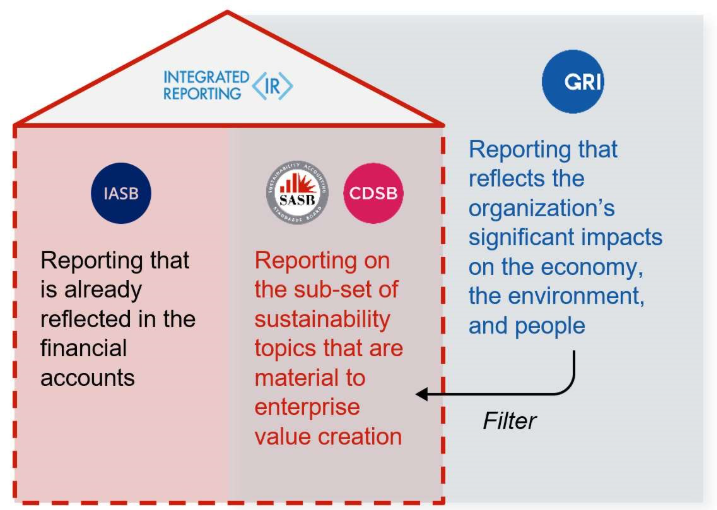
Whether or not the Foundation accepts this specific formulation or has a different framework in mind, we believe it would be unwise to work with different reporting organisations or to develop new standalone standards that are different or incompatible with existing standards, particularly when the Five are making progress in with their efforts.
It will be important for SSB to engage with the group of Five, either individually, collectively– or both– and to develop a clear vision to coordinate with them and best make use of their capabilities and the tools we already have. It is beyond ICGN to anticipate if this might give rise to more mergers or organizational consolidations involving the Five or other reporting bodies. But it would not surprise us if there were to be further restructuring or organisational rehousing. To the extent this were to involve the Foundation or SSB we can only encourage avoiding a scenario in which there are perceived “winners” and “losers,” as all these bodies have made positive contributions to where we are now, and their capabilities and human capital will help to shape future solutions.
While we will address below how the urgency of climate change relates to other sustainability issues, we also would like to highlight the Task Force on Climate-Related Disclosures (TCFD) and its framework for disclosing climate related risks. As an initiative of the Financial Stability Board (FSB), the TCFD has received support in many markets around the world and the TCFD disclosure framework has been embraced by many investors and companies as a basic, but logical, reporting structure aimed at four different categories: governance, strategy, risk management and metrics/targets. This is a logical structure that may also apply well to other sustainability reporting models, and we encourage the SSB to consider how the TCFD framework might feature as a part of its overall standard setting.
Scope (consultation questions 7,8)
In our internal review, members of ICGN’s Disclosure and Transparency Committee expressed a very clear preference for the SSB not to limit its initial focus to climate risk. We certainly believe that climate is a clear and urgent priority – and the TCFD might provide the SSB with a good head start to work with. But climate is not the only priority. Sustainability has other important environmental, social and ethical dimensions, and we believe the SSB should lay down a broad foundation in its initial effort rather than prioritise one sustainability theme.
Materiality and audit (consultation questions 9 and 10)
As a technical matter, materiality is one of the most challenging issues in sustainability reporting, particularly as some of the leading standard setters work with differing approaches to materiality. We are sympathetic with the suggestion for the SSB to begin with “single” materiality, focusing on the financial materiality of sustainability on the corporate reporter. This might be the most sensible way for the SSB to get off the ground, and would align with the existing approach taken by SASB, with its clear financial and investor orientation,
But this should be regarded as the first stage of a longer term journey which could lead the SSB also to address double materiality issues – how the company itself impacts society and its stakeholders. The growth of impact investing, with its dual goals of achieving both investment returns and positive social impact, suggests a building need within the investment community for sustainability information that addresses both dimensions of materiality. The broader scope of dual materiality also meshes with the multi-stakeholder focus of the GRI. Investors are increasingly interested in both dimensions of materiality to guide investment decision-making, engagement and voting. Ultimately the challenge is to better understand “dynamic” materiality, in particular how sustainability factors that are not immediately financial in nature can have material financial impacts on companies.
Audit is an important element of a successful sustainability reporting system. Investors should come to expect an independent and rigorous audit or assurance process to provide them with similar levels of comfort as auditors provide in financial reports. Again, this amounts to a journey, and there remains scope for improvement. But this should be part of the SSB agenda going forward. Here again, focusing on audits or assurance from a single materiality perspective will probably be a more straightforward starting point; but the ultimate ambition should extend to double materiality as well.
We hope that our comments are helpful, and we look forward to engaging with you in this or other matters where we could provide meaningful input. Should you wish to discuss our comments further, please contact me or George Dallas, ICGN’s Policy Director, by email at george.dallas@icgn.org.
Yours faithfully,
Kerrie Waring,
Chief Executive Officer, ICGN
Copy: James Andrus, Chair, ICGN Disclosure and Transparency Committee: James.Andrus@calpers.ca.gov