
The Rt Hon Rishi Sunak, MP Chancellor
HM Treasury London
Sent by email: Karis.Alpcan@hmtreasury.gov.uk
12 November 2020
Re: Financial Services Statement 11/20
Dear Mr. Sunak:
Led by investors responsible for assets under management in excess of US$54 trillion, the International Corporate Governance Network (ICGN) is a leading authority on global standards of corporate governance and investor stewardship. Our membership is based in more than 50 countries and includes companies, advisors and other stakeholders. ICGN’s mission is to promote high standards of professionalism in go vernance for investors and companies alike in their mutual pursuit of long-term value creation contributing to sustainable economies world-wide. ICGN has long been active in promoting good corporate governance in the UK1, and our investor members hold significant equity positions in UK companies.
We are writing this letter in response to the Financial Services Statement 11/20 (Statement) that was published by HM Treasury on 9 November 2020. There are many positive features to this Statement, particularly the emphasis on sustainable finance and more robust disclosure standards relating to climate change and other environmental, social and governance (ESG) risks. We also support the Treasury’s ambition to enhance the UK’s attractiveness as a global financial centre, and in our view, it is the UK’s robust regulatory standards that are most fundamental and distinctive to this attractiveness.
However, we are concerned that the quality of these regulatory standards may be under threat. While the Statement itself provided little detail about the planned review of the UK listing regime, it has been widely reported that this review will consider the introduction of a dual class share regime and lowering current free float standards.
Our message to you is that such developments would be unwelcome by a substantial number of institutional investors globally – who are critical stakeholders in the ecosystem of the UK’s financial markets. It would lead to lower corporate governance standards, and could threaten, not enhance, the reputation of the London Stock Exchange globally. With this letter we would like to explain why.
We fully appreciate concerns by companies that investors with short-term perspectives may wish to encourage companies to improve short-term results – at the possible expense of long-term value creation. However, from our perspective representing global institutional investors, we find this proposal problematic in two key ways:
- Dual class shares and a lower free float ultimately marginalise minority investor rights and diminish the accountability of executive managers to shareholders. As an investor body with a focus on developing long-term investment perspectives by institutional investors, we are sympathetic to concerns of short-termism that might lie behind this legislative initiative. But we believe that dual class shares and are a seriously flawed tactic with unintended consequences and we strongly discourage legislative initiatives to introduce differential ownership structures in or other jurisdictions.
- At a time in which regulators around the world are introducing stewardship codes to encourage investors to play a greater, and more responsible, role in monitoring company governance, engaging and informed voting, the imposition of differential ownership rights has the effect of watering down investor influence in a way that is anathema to the goals of investor stewardship. ICGN has publicly described this phenomenon as “regulatory schizophrenia”.
Dual class share structures: ICGN position
ICGN has regularly commented about differential rights in regulatory consultations around the world and has also expressed its views in a Viewpoint report.2 Our message is consistent: ICGN and its members are fundamentally opposed to differential ownership rights, dual class share structures and the separation of economic ownership and voting control. We believe these structures are fundamentally flawed and carry significant governance risks for minority shareholders by diluting minority shareholder protections, management entrenchment and limited accountability. In extremis such structures create opportunities for expropriation, with controlling shareholder gaining private benefits of control at the expense of minority shareholders.
We are concerned in particular that we are witnessing a “race to the bottom” by major global stock exchanges seeking to attract listings by watering down governance safeguards. In 2017, in an ICGN membership poll, 84% of ICGN members disapproved of differential voting right structures and 67% believed that differential voting structures would impact negatively stock valuations.
Evidence base
It is critical to consider the evidence base with regard to loyalty shares or other forms of differentiated ownership. While the motivations behind allowing for double voting rights are often based on a laudable desire to promote long-term perspectives on investment value creation, it is important to understand how effective dual class structures may be in practice – and what unintended consequences of differential ownership might imply.
The French Loi Florange, enacted in 2014 has provided opportunities to study the impact of loyalty shares with double voting rights in the French market, which has certain similarities to what is being considered for Brazil. In this regard we cite two recent studies which negative outcomes from loyalty share structures
- A 2018 study of French listed companies by Becht (ECGI), et al concludes that companies that did not convert to a dual class share structure have a significantly higher market to book ratio than companies forced into a dual class regime.3
- Another recent study of French companies by Bourveau (Columbia Business School) et al found that French firms that adopted double voting rights by default — especially those with a large block holder — experience a decrease in foreign institutional ownership and an increase in cost of capital relative to other firms. Furthermore, the market reacts positively to successful opt-out votes. Collectively, the evidence casts doubt on the merit of regulation-induced tenure voting as a desirable corporate governance mechanism.4
We also cite academic evidence focused on the US, where the research history goes back further. These studies also suggest that minority shareholders may be the net losers in differential ownership arrangements:
- A recent research literature review of differential ownership by Stanford University academics Larcker and Tayan concludes “the evidence suggests that companies with dual-class structures tend to have lower governance quality”.5
- In an empirical study of dual class structures in the United States, the study’s authors (Gompers, Ischii and Metrick of Harvard, Stanford and Yale, respectively) concluded “we find that firm value is positively associated with insiders’ cash-flow rights, negatively associated with insiders’ voting rights, and negatively associated with the wedge between the two.” The authors go on to say that “a majority owner of a private company can rationally choose to sacrifice some firm value in order to maintain private benefits of control.” That may be well and good for the controlling owner. But it also suggests that these private benefits come at a cost to minority investors.6
- A study of dual class share structures by Harvard Law School academics (Bebchuk and Kastiel) outlines the risks of entrenchment, self-dealing and perverse incentives that come with dual class shares, noting that there is an “untenable” case for perpetual dual class shares. They state that “as time passes the potential costs of a dual class structure ten to increase and the benefits tend to erode.” The authors propose a requirement for sunset provisions in cases where such structures exist.7
- Robert Jackson, a former Columbia Law School Professor, and currently a Commissioner at the US Securities and Exchange commission also recently articulated similar reservations about dual class share structures. Like Bebchuk and Kastiel he is not an advocate of dual class shares, and also supports the use of sunset provisions in cases where they exist. His own research suggests that if there is an advantage to dual class structures, such structures should not be permanent as they can lead to value deterioration over time.8 The following graph makes this point clear:
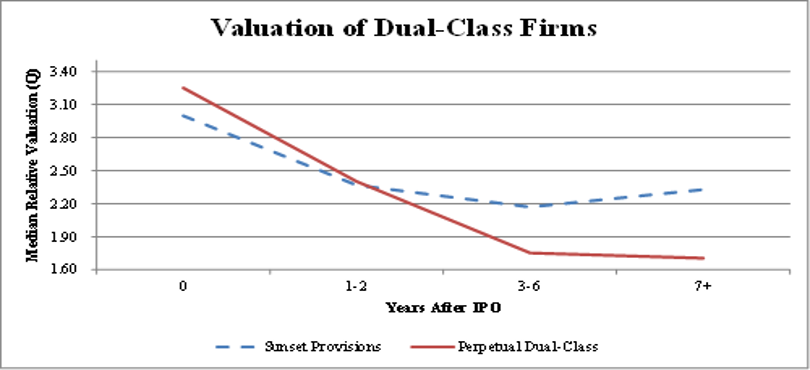
Source: Robert Jackson, US Securities and Exchange Commission, 2018
From this body of research, we believe there are strong theoretical and empirical foundations that demonstrate the risks that dual class voting rights bring to minority investors. Though much of this research was based in the US, we believe it also has relevance in other markets globally, including the UK. While the risks of dual voting class structures can ultimately be priced into a company’s valuation, we believe the most sensible starting point is simply to avoid the introduction of dual class share regimes in the first place. Otherwise we fear there is a slippery slope to unintended consequences, even with the best of intentions. This would negatively impact in the long run both companies and investors.
Conclusion
The UK Stewardship Code seeks to encourage and empower shareholders to use their voting rights intelligently and responsibly to hold companies to account on key matters including board composition, remuneration and capital resolutions. The introduction of dual class share structures and lower free float standards in the UK would be anathema to this: it would have the effect of watering down the voting voice of shareholders to the point that minority shareholders do not matter. It would position the UK as a retrograde follower in an unseemly and inappropriate “race to the bottom,” sparked in part by the attraction of listing fees to the London Stock Exchange –itself a for-profit company. Again, we emphasise that this would not be welcomed by institutional investors—who are critical stakeholders in the UK’s financial ecosystem.
We hope these comments are helpful with regard to your deliberations on these matters. Please contact ICGN Policy Director George Dallas if you would like to discuss this in further detail: george.dallas@icgn.org
Yours sincerely,
Kerrie Waring
Chief Executive
Copies:
Bram Hendriks, Co-Chairman, ICGN Shareholder Rights Committee, BHendriks@ktmc.com
Eugenia Unanyants-Jackson, Co-Chairman, ICGN Shareholder Rights Committee: Eugenia.Jackson@AllianzGI.com
1 See ICGN letter to the UK Financial Conduct Authority (2019): https://www.icgn.org/sites/default/files/ICGN%20Response%20to%20the%20Discussion%20Paper.pdf ICGN comment letter to the Financial Reporting Council on the UK Stewardship Code (2019): https://www.icgn.org/sites/default/files/ICGN%20Reponse%20to%20the%20Proposed%20Revision%20t o%20the%20UK%20Stewardship%20Code%20-%20March%202019.pdf
ICGN comment letter to the Financial Reporting Council on the UK Corporate Governance Code (2019): https://www.icgn.org/sites/default/files/4.%20ICGN%20Comment%20FRC%20UK%20Corporate%20Go vernance%20Code%20Consultation%20Feb%202018_0.pdf
2 See ICGN Viewpoint on differential ownership structures, February 2017: https://www.icgn.org/differential-share-ownership-structures and its Viewpoint on the inclusion of non- or limited-voting shares in stock indices, November 2017: https://www.icgn.org/inclusion-non-voting-or-limited-voting-shares-stock-market-indices
3 Becht, Marco and Kamisarenka, Yuliya and Pajuste, Anete, Loyalty Shares with Tenure Voting – A Coasian Bargain? Evidence from the Loi Florange Experiment (April 2018). CEPR Discussion Paper No. DP12892. Available at SSRN: https://ssrn.com/abstract=3171160
4 Bourveau, Thomas and Brochet, Francois and Garel, Alexandre, The Effect of Tenure-Based Voting Rights on Stock Market Attractiveness: Evidence from the Florange Act (January 27, 2019). Available at SSRN: https://ssrn.com/abstract=3324237 or http://dx.doi.org/10.2139/ssrn.3324237
5 See: David Larcker and Brian Tayan, “Corporate Governance Matters”, Second Edition, Pearson Education Inc., 2016, page 333.
6 See: Paul A. Gompers, Joy Ishii and Andrew Metrick,” Extreme Governance: An Analysis of Dual Class Firms in the United States “Review of Financial Studies 23 (2010): 83-120.
7 See: Bebchuk, Lucian and Kobi Kastiel: The Untenable Case for Perpetual Dual-Class Stock, Discussion Paper No. 905, Harvard Law School, April 2017, pp 1-6.
8 See: Jackson, Robert J. Jr. (2018) Perpetual Dual-Class Stock: The Case Against Corporate Royalty, U.S. Securities and Exchange Commission: https://www.sec.gov/news/speech/perpetual-dual-class-stock-case-against-corporate-royalty#_ftn19