
ICGN Systemic Stewardship & Public Policy Advocacy Toolkit
September 2023
Getting Started
This Toolkit has been developed for investors to assist with the necessary strategy approaches and decisions as they consider enhancing their systemic stewardship objectives with a plan for public policy advocacy on behalf of their beneficiaries and clients.
ICGN recognises that investors have a spectrum of stewardship responsibilities and a plan for public policy advocacy may be a new consideration. Therefore, the Toolkit contains guidance to assist with scaling the implementation, tracking, and reporting of the plan that fits each investor’s fiduciary responsibilities.
What is Included
The Toolkit contains:
- Defining Public Policy Advocacy as a Systemic Stewardship Tool Page 2
- The Rationale for Using Public Policy Advocacy Page 3
- Assessing Needs and Resources Page 4
- Creating the Strategy Page 4
- Developing the Public Policy Approach Page 5
- Implementing Your Plan Page 9
- Tracking Progress Page 10
- Reporting Page 11
- Conclusions Page 11
- Resources
Appendix 1 – Potential Themes for Consideration Page 12
Appendix 2 – Considerations for Public Policy Approaches Page 14
Appendix 3 – Case Studies Page 16
Appendix 4 – References and Further Reading Page 17

Defining Public Policy as a Systemic Stewardship Tool
Public policy can be defined as “anything a government chooses to do or not to do”.1 A government’s actions (or decisions not to act) are guided by its legal formation, authority to set regulations and policies, and political philosophy. How national governments interact with each other, or with supranational bodies, to set harmonised public policy objectives, is increasingly important for global, diversified investors. In many ways, the strategies, tools, and tactics that are useful to positively influence policymakers have much in common with those required by investors to positively engage and influence companies. Investors have adapted their engagement strategies to scale this work based on investment priorities and available resources. The same can be said with adding public policy advocacy to an investor’s toolkit.
The potential combinations of these tools and tactics are endless, which gives investors a way to customise their use to suit their fiduciary obligations and stewardship objectives. However, they can be broadly categorised in taking an initial step, such as educating and advising on broad policy topics, to a more advanced step, that of engagement through an external platform on public policy issues. The Overseas Development Institute’s (ODI) Start and Hovland (2004) report provides a helpful diagram for categorising “tools for policy impact”.2 We have built on their work and refined it in a way to be targeted for investors:
As the diagram shows, it is possible to plot activities on axes which outline: i) the extent to which an investor (or another organisation) is considering whether to undertake an internal or more external public-facing approach; ii) the nature of the advocacy, e.g., whether there is a specific ‘ask’ in mind or if the organisation is simply laying out and/or providing evidence for a broad range of possible solutions; iii) whether the approach is evidence-based or values-based; and iv) the degree of involvement, from advising on a policy issue to actively pursuing a policy change. Each policy issue may necessitate a determination of how to approach the issue, within the public policy framework set by the investor.
The Rationale for using Public Policy Advocacy to Support Stewardship Objectives
As investment institutions grow in scale and become increasingly diversified, more investors can be considered as ‘universal asset owners or managers’, where their portfolios constitute a ‘slice’ of the global economy and whose performance is tied to the success of the economic system at large.3 This means that an optimal approach to portfolio risk management should consider the deployment of systemic stewardship strategies to understand and mitigate not only company-specific risks, but also system-wide risks presented by a range of challenges such as climate change, biodiversity loss, global pandemics or wealth inequality.4
In recognition of these developments, several investment institutions are collaborating to engage companies across sectors to mitigate or eliminate risks presented by governance, environmental and social challenges. Indeed, recent investor collaborations focused on systemic risks are focused on mitigating market-wide governance, environmental and social risks by influencing corporate behaviour within sectors or specific markets. For instance, there is already evidence that the work of the several coalitions has played a role in helping companies reduce systemic risks.5
Investment institutions also recognise that system-wide risks can and ought to be recognised, managed, mitigated, or eliminated at least in part by national and international policy frameworks. For this reason, investors should consider enhancing their ability to influence public policy in ways that align with the best possible aggregate outcomes for their beneficiaries. Systemic stewardship programs provide a means to expand beyond company engagement and proxy voting to include positive contributions to public policy debate, legislation, regulation, and other forms of standards-setting.6 Membership in organisations such as ICGN can provide investors with the tools to support the educational and public policy advocacy within the bounds of a global organisation that supports members who may not have additional resources.

Assessing Needs and Resources
Investors may need to consider amplifying or adding new resources when implementing a public policy programme as part of their systemic stewardship approach. The decision is an individual one for each investor, depending on its own determination of fiduciary responsibilities. We have provided questions for consideration to assist in the review, from a discussion whether the investor should get involved and if so, what is the positive end result that the investor is trying to achieve.
1. Should we get involved?
- The nature of the issue itself. How do we identify and decide what is important to us and our beneficiaries? Is public policy work likely to be a helpful tool? Is the issue system-wide or regional/local? Are the markets in a particular jurisdiction likely to respond to regulatory action?
- The nature of internal expertise. Do we have the requisite skills, resources, and capacity to get involved and stay the course? Are we likely to succeed in the appropriate timeframes or do we recognise that the effort may take a number of years?
- The discussion of risk. Have we considered potential risks for getting involved? Is there a risk if we do not get involved? Is it possible to request specific action without harming our investment strategies or ability to manage funds for beneficiaries?
- Engage-ability of the issuer. If the policymaker is not willing to take part in meaningful engagement, it may not be practical or worthwhile to pursue or prioritise.
- What are we trying to achieve?
- The context (the politics and policies). Is the engagement in response to a request for comments around a proposed rulemaking; a collaborative investor call for government action; in response to proposed legislation; or engagement as a sovereign debt or minority shareholder? Which activities should be prioritised given limited resources?
- The ‘ask’ and evidence base. What are our key messages and desired outcomes? Do we have credible evidence or data to support our claims/position? What evidence/messages will be most persuasive and noteworthy? What messages are authentic to us, e.g., our own finely crafted talking points that may be different from what others might say.
Creating the Strategy
Investors, as with companies, have to prioritise their long-term goals and objectives. Strategies to advance their public policy outreach will require dialogue on the appropriate level to get involved, with whom they may wish to partner and how to determine whether escalation of the initial strategy is necessary. The pros and cons will need to be weighed and pivot points identified should a strategy need to be revised as the situation is playing out.
Questions include:
- How should we get involved?
- The most appropriate individuals or organisations to target. Should we consider regulators and legislators on a national, local, or regional level? Should we seek to influence party policy or government policy? Are local, national, or supra-national policymakers the most appropriate targets of our advocacy?
- The available, and most relevant, mechanisms. Should we produce our own research, data and talking points? Should we seek meetings with staff or elected officials, or write letters? Do we issue a response to a request for comment from a regulator on a proposed rule? Should we participate in a regular consultation process? Do we do this together with others or alone?
- Any red lines for escalation. When should we shift from a private intervention to a public one? What are the most appropriate methods for escalation – e.g., move to collaboration with likeminded investors and stakeholders, explain the consequences of action or inaction, including a changed sovereign valuation, downgraded investment outlook in the market, or divestment as a last resort?
- Broader positioning and brand. Are we acting in a way that positions us as constructively helpful and a knowledgeable resource for information?? How does our systemic stewardship activity influence our beneficiaries or stakeholder perceptions of our organisation? Will our position stand the test of time if the need to advocate continues for several years?

Developing the Public Policy Approach
Good public policy, like good company engagement, takes time. Building strong relationships both externally and within the investor’s own organisation, and achieving the outcomes, requires patience. Although public policy engagement does not necessarily require excessive levels of stewardship resource, building long term relationships and achieving results can often take a year or longer.7
The best public policy approaches will be aligned with an investor’s other stewardship activities, such as individual company engagements, collaborative (company-focused) initiatives, exclusions, and use of voting and other ownership rights.
The following diagram, created by the ICGN Global Stewardship Committee, identifies the steps forward for building a public policy strategy:
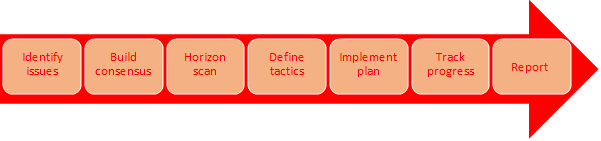
- Identify issues. Although systemic issues are axiomatically system-wide, there will be some that resonate more with a specific investor than others.8 Investors are not monolithic; therefore, each strategy may be developed for the individual investor. The nature of the considerations may also vary based on whether the investor is an asset owner or manager.
Ideally, public policy advocacy should be only one of the stewardship tools investors choose to exercise. The most effective policy positions and advocacy are aligned with voting and company engagement activity.
We outline some possible systemic issues that investors may want to consider in Appendix 2. The case studies in Appendix 3 provide different investors’ approaches to, and criteria for, agreeing to stewardship priorities.
- Build consensus. There are several different internal stakeholders that should be consulted/considered when stewardship professionals are considering a public policy strategy. Obtaining organisational buy-in will be important to ensure investors leverage existing internal resources.
- Senior Stakeholders/Leadership
Senior leadership within an organisation should remain apprised of policy input activities, at least at a high level, and at a more detailed level depending on the issues and audience. Organisational process may also require approval from these stakeholders. They may also have a more holistic view of the organisation and an understanding of key strategic and long-term goals that can inform the substance of a policy position.
- Portfolio managers and analysts
While the Toolkit covers public policy from a systemic stewardship perspective, there may be specific portfolio companies that are potentially affected by an investor’s public policy activity on a particular issue. Stewardship and other professionals wishing to undertake public policy activities should consider whether such work will impact major holdings or affect existing or future relationships with portfolio company representatives.
Such an impact may not be insurmountable or create a contractual issue, but we would encourage consultation with the portfolio managers and even an early heads-up to the investor relations contacts at potentially affected companies.
- Legal and Compliance
Legal and Compliance functions bring an important perspective to any policy work due to their subject matter expertise regarding the legal and regulatory environment. They may also need to approve any statements to external third parties before they are released. Involving these functions early and regularly throughout the process will result in more robust positioning and avoid potential hurdles later in the process.
- External/Government/Public Relations Professionals
Institutional investment organisations are becoming more conscious of the political and policy environment in which they operate. Beyond the responsible investment or stewardship team, institutional investors will likely have a team which is either responsible for government affairs specifically, or external relations generally.
Although some of the most impactful advocacy work takes place privately, for instance through meetings with officials, public advocacy tactics – such as responding to a consultation, are also relevant.9 Obtaining buy-in from the team responsible for the investor’s external-facing work, will be important.
It is likely that investors will need to do this early on (on the principle of public policy advocacy, as well as the strategy) but also more regularly and at a more granular level as they proceed through the policymaking life-cycle. Leaning on the expertise of an internal PR, Communications or Government Affairs team in understanding reputational risk (e.g., through asking them to review a draft consultation response) is invaluable. Individuals on these teams will also likely have broad-based political and policy networks that could be of use to help investors set up meetings and discussions.
- Scan the policy horizon. As with other forms of engagement, preparation is key to ensure effective planning and resource allocation. It may seem true that, as the saying goes, “a week is a long time in politics”, regular horizon-scanning for forthcoming legislative milestones or developments is invaluable. Many regulatory bodies will issue an annual statement of potential regulatory topics, and some may even provide a framework for two
or more years of possible activity.
There will be several different sources for finding this information, including:
- Government, regulatory, legislative arm, and standard setter websites. These are good sources for consultations and discussion papers, which themselves will usually have a ‘next steps’ section flagging future developments. Investors should identify those regulators, key legislators or government departments in those jurisdictions that are most relevant to the prioritised themes.
- Engagement with officials. Government officials and regulators are increasingly open to discussions with investors, either individually or in groups.10
- Organisational or adviser newsletters. In light of significant regulatory change, membership organisations and investment advisers often include the latest developments in their newsletters. For instance, the ICGN regularly emails its members with news of corporate governance, responsible investment policy debates and opportunities to respond. Once gathered, the most relevant information should be stored centrally with the key dates, themes and sources highlighted for easy access. Ensuring this is a ‘live’ document, which is frequently updated, will be key.
- Define the tactics and approach. Once an investor identifies what issues to engage on, and what opportunities are upcoming, the investor will need to consider what approach will work most effectively. Investors may also wish to consider how these issues relate to the “Overton Window of Political Possibility” as this may help determine timing and approach.11
- Proactive or reactive? Horizon-scanning may have spotted key opportunities, such as forthcoming consultations, which align with stewardship priorities and to which investors can respond. This is reactive and will usually be a relatively low resource cost.
Alternatively, if no suitable opportunities present themselves, and investors consider the matter to be pressing, they may want to consider a more proactive approach. This could include suggesting meetings to government officials, standard setters, membership organisations and elected representatives to try to understand the landscape and the best way forward.
- Research on specific issue. Investors may also wish to undertake and publish research on a specific issue, exploring the state of play, assessing potential mitigation activities and, ultimately, making recommendations to policymakers (and other audiences). This could be particularly helpful if they are seeking a broader mindset or “Overton Window” shift.
- Select the best opportunities. On occasion, a particular priority issue may become a priority for policymakers and there may be a significant number of opportunities to pursue the issue but only a finite level of resource. Criteria that may help when prioritising include:
- Level of department or regulator involved. Is the opportunity being overseen by a government department or a regulator, or other department-sponsored entity? Influencing at the government department level may have greater impact as thinking will likely be at a more emerging stage. Conversely, responding to a regulatory consultation – particularly if the investor is one of the regulated entities within its remit – may have a more tangible impact on their day-to-day activities as a responsible investor.
- Level of expertise. Does the engagement team genuinely have something relevant and worthwhile to contribute that adds real value? If investors are likely to have to expend significant levels of effort to contribute in a meaningful way, then there may be better opportunities, or more resource-efficient ways to contribute. For instance, committing to publicly support an aligned organisation’s advocacy effort or citing alignment to the public positions or priorities of member organisations can be both resource effective and impactful.
- Likely strength of opposing viewpoint. Is the issue one where particularly strong advocacy in opposition to the investment perspective is likely to take place? Is the investor voice or contribution likely to be muted, for whatever reason, or will the involvement trigger side issues that, while not related, create a diversion from the issue at hand? If so, investors may want to prioritise a contribution – and even encourage other investment and stewardship practitioners, and organisations to take the lead.
- Collaborative or individual engagement? As with any company engagement, investors need to consider whether they have a sufficiently distinctive voice, position, and resource to be able to educate and favourably influence policymakers, individually. If this is not the case, and if investors can find an initiative or grouping which is aligned with their perspective, collaborating with others on letters or submissions may be the most appropriate choice.
The right level of collaboration can be particularly useful for several reasons:
- It can help mitigate any accusations of self-interest (aimed at a specific investor) by allowing a group of aligned organisations to speak with one voice.
- It can result in a pooling of resources, meaning less resource commitment required by any one organisation.
- It can enable leverage of others’ expertise, skills, and relationships to produce a more impactful intervention or initiative.
- It can add to the mass of support for an initiative, strengthening the chances of being heard by policymakers.
- It can create a higher level of beneficiaries for whom the engagement is undertaken and provide a higher level of assets under management (AUM), numbers that can help clarify the impact of a successful engagement.
- What is the best mechanism? As with company engagement, consideration needs to be given to the most appropriate way of communicating a message or policy position. This includes:
- A letter or other written response (private)
- A letter or other written response (public)
- A “private” meeting with officials, regulators, or standard setters
- A “private” meeting with elected representatives
- Issuing a public statement to the press, or other external outlet (e.g., speaking at a conference)
However, publicly commenting against an action should be considered an escalation tactic and will likely be used where i) an investor deems an issue to be of critical importance and ii) the investor has undertaken one or more of the activities outlined above and feels greater progress should be made. Extensive internal discussion in advance will be required, and sign-off will likely need to take place at the most senior levels. It is important that the comments remain focused on the legislation or rules proposed.

Implementing Your Plan
- Objectives and KPIs. As with any company engagement, objectives should be set in advance of any activity. What are you looking to achieve? What does success look like? What would failure look like? What would the best possible outcome be, and do you have a minimum acceptable outcome? KPIs should ideally be outcome-based and there should be regular opportunities for review scheduled (please also see Reporting and Tracking progress below).
- Resources, roles, and responsibilities. Investors need to understand the estimated length of the campaign, and what internal and external resources will need to be allocated to it. It will also be important, particularly where other organisations are involved in any collaborative effort, to establish each participants’ roles and responsibilities. This may include the issue ‘lead’, the nominated spokesperson, the communications lead, the research partner and, ideally, provide clarity around the decision-making processes. Many collaborations incorporate this information into a ‘Terms of Reference’, ‘Memorandum of Understanding’ or ‘Statement of Works’ document.
- Key messages/a database of research. As well as clarifying what investors want to achieve (and what they would accept), investors will need to agree and have on hand key messages. These will capture succinctly the main points investors are wishing to make and should be tailored for different audiences, taking into account any statutory (or other) objectives for each audience and/or decision-maker. This should help with consistency in messaging across different individual initiatives. Ideally, the investor position will be backed up by evidence. This could be from research investors have undertaken themselves, or a collation of academic or industry research produced by others.12
- A one-pager/briefing pack. Creating a short briefing note that can be edited for use by, for instance, officials or senior spokespersons, may be useful in ensuring consistency and alignment of messaging.
- A project timeline of all systemic stewardship activity. It can be helpful to produce a timeline of activities that maps each of the different strands of work against each other, to clarify where and how resource will be allocated, and any dependencies. Strands could include thematic voting, collective or direct company engagement, public policy (perhaps in different jurisdictions), or engagement with other market participants.
- A stakeholder ‘heat-map’. Horizon scanning and other information gathering should provide investors the necessary information they need to identify who are the most influential stakeholders (organisations and individuals). When cross-referenced against their likely interest levels, this will help guide further prioritisation of targets and resource expenditure.
- A list of useful/interested media contacts.

Tracking Progress
As with any company engagement, regular opportunities for review should be scheduled and any lessons learned should be documented for future implementation or projects. Measuring outcomes achieved through policy advocacy, particularly for an individual or single organisation, is difficult: how can one organisation, which may well have been pursuing a similar policy objective to others, assess whether and to what extent it was their advocacy that made a difference? A few possible indicators are detailed below:
- Mention of the investor’s consultation response or positions taken in the government response or follow-up communications;
- Invitation to join government or regulatory working groups on a particular issue; and/or
- Individual invitation to provide feedback at an early stage to the next phase of policymaker discussions on a particular issue.
We reinforce the recognition that real and fundamental policy change takes time. Outcome-based indicators, unless for a specific consultation response, should accordingly be long-term.

Reporting
Certain advocacy may be most effective when undertaken privately. However, in the same way that investors are increasingly calling for companies to be transparent about their advocacy activities13, investors should seek to be transparent to their own stakeholders. This could be through a number of channels:
- Publishing the list of membership organisations to which the investor belongs (on a website or making publicly available elsewhere14), and details of the supported activities undertaken by such organisations.
- Publishing consultation responses on the investor’s website.
- Producing case studies on public policy advocacy in client- or member- facing documents (such as Stewardship Reports); and
- Organising an internal meeting, or producing an internal report, for key organisational stakeholders.
We also note that in certain jurisdictions, unless confidentiality is specifically requested, policymakers reserve the right to reproduce excerpts from investors’ responses to consultations.
Conclusions
The public policy advocacy tools and tactics available for investors in the public policy arena represent a continuum of opportunities to engage and help shape good public policy decisions that support investors, the capital markets, and the beneficiaries to whom they owe a fiduciary duty. At the beginning of activity, singular acts, such as writing a comment letter, require limited resources; however, as one moves across the spectrum, the advocacy becomes more involved and more resource intensive. Investors may move from one end of the spectrum to the other, or stay somewhere in the middle, depending on the issue at hand.
The investor voice is powerful and when used effectively, can create positive relationships to help shape future policy initiatives and provide legislators, regulators, and standard setters with views from experienced and knowledgeable investors.
RESOURCES
APPENDIX 1 | POTENTIAL THEMES FOR CONSIDERATION
Although each investor will want to focus on those topics that are most aligned to their specific portfolio and purpose, we suggest some potential topics for consideration in any ‘materiality matrix’ or similar document:
- Climate Change and the Just Transition: Government action on climate continues to gain momentum around the world as governments strive to meet commitments to reduce emissions under the Paris Agreement.15 This activity not only will have an impact on the operating environment and the investment universe16, but also on investors and investment activities, and ultimately their beneficiaries.17 Policy engagement in this area can run the gamut from supporting emissions disclosure requirements for market actors to national emissions pricing schemes.
- Income inequality and the cost of living. The pandemic’s impact on people’s lives and livelihoods, and the new inflationary environment faced by many people worldwide means it is not surprising that respondents to the 2022 World Economic Forum (WEF) Global Risks Report chose “Social cohesion erosion” and “Livelihood crises” as their fourth and fifth “most severe risks on a global scale over the next 10 years”.18 For investors, there is a clear interface with company and policy engagements on labour relations, workforce treatment and fair pay practices (the last potentially adding an extra dimension to engagement with firms on remuneration practices).
- Biodiversity loss. Supporting biodiversity is just one way in which businesses and society benefit from nature and its ecosystem services. We refer to assets that underpin these services as “natural capital”, while biodiversity refers to the breadth of living components that constitute this capital. Biodiversity remains an emerging theme, owing to difficulties regarding the lack of available data.19 Engaging with government decision-makers in jurisdictions that are at high risk of biodiversity loss, or with the Taskforce on Nature-Related Financial Disclosures (TNFD) are perhaps some of the most effective stewardship activities at present.
- Diversity, Equity and Inclusion (DEI). There is a clear body of evidence showing that cognitively diverse groups make better decisions as they are less prone to behavioural biases such as groupthink and overconfidence.20 This is also one of the sustainability themes which is easier to measure, and where policy and regulation means data availability is improving beyond that for other thematic issues (particularly in the US and European markets). Although historically investor activity on DEI has been focused on Board-level diversity (and, to a lesser extent, diversity of the Senior Management Team), there are moves to measure and act upon broader workforce diversity data.21
- Rule of Law and anti-corruption measures. Rule of Law is necessary to support security of any long-term investment in any asset class and any jurisdiction, as it gives investors’ confidence that businesses will be held accountable for their actions and that shareholders, workers and other stakeholders will be protected.22 Engaging on the presence of anti-corruption, whistleblower protection, anti-bribery and other measures at a jurisdiction-wide level is one approach, but investors can also engage with companies in at-risk sectors and jurisdictions on the measures they have in place to mitigate bribery and corruption, including oversight of their supply chains.
- Responsible tax practices. Recent years have seen significant steps taken towards global tax reform, owing to concerns that multinational firms are not paying the appropriate rate of tax.23 While the pursuit of tax avoidance by individual companies can have significant reputational impacts and, in the current policy environment, increase the risk of regulation that affects long-term financial performance, there are also systemic risks from tax avoidance. These include negatively affecting the ability of governments at all levels to invest in the necessary infrastructure (physical and intangible) to support healthy economies and societies.24
- Stewardship and shareholder rights. To be effective stewards of assets, investors need to be able to fully wield ownership rights, and companies need to be incentivised to listen to their wider shareholder base and be subject to market discipline. Anti-takeover measures – such as multiple or dual class share structures (DCSS) – insulate company executives from the market and minority shareholders. Policymakers can enable or prevent multiple-class share structures (and other poor governance practices), as demonstrated by recent moves in the UK market to enable DCSS on the Premium segment of the London Stock Exchange25 – with similar debates being held in Italy and Germany and other jurisdictions currently. Investors may desire to collaborate to engage with policymakers on what is a fundamental issue for investment stewardship.26
- Access to medicine. The pandemic threw inequitable access to vaccines and other vital medicines, and implications for health and wellbeing, into sharp relief. Although an increasingly core part of investor engagement with companies in the pharmaceutical and biotech sector, national and international policymakers have an important role to play in ensuring both inter- and intra-national equality of access to vaccines and other important medical products.27
APPENDIX 2 | CONSIDERATIONS FOR PUBLIC POLICY APPROACH
A matter of jurisdiction
Any involvement in a policy debate or regulatory discussion by an investor must abide by the regulations of the jurisdictions involved.
Although there are exceptions to the rule, investors are generally encouraged to avoid the perception of bias by focusing their approach to educate government or non-party-political policy makers (such as non-partisan government officials or regulators) for example, on their involvement in the capital markets, the need for oversight in particular areas or by seeking meetings or disseminating briefing materials to all parties equally.
Within the spectrum of public policy choices, there could be opportunities to utilise a public comment period, for example, to fulfil their stewardship responsibilities. Investors should always refer back to the specific political regulations and policy context of their own jurisdiction.
Overcoming concerns about ‘political lobbying’
Investors should carefully consider framing and emphasising i) the necessary role investors can play in providing expert information or advice; ii) expectations by beneficiaries or third-parties that investors will participate in the process (e.g., UK Stewardship Code/PRI) ii) the legitimacy of participating in policy debates as part of an investor’s fiduciary duty; iii) any steps that will be taken to minimise the impression of being seen to be partisan, or other negative repercussions..
It may also be helpful to agree up front a process for sign-off of any activities or positions by senior stakeholders or leadership.
The role of standard-setters
Although public policy advocacy has traditionally focused on officials and elected representatives, standard-setters are an increasingly important constituency for investor advocacy programmes. This is in light of growing demand from investors and companies for sustainability, ESG information and metrics that are clear, consistent, and comparable. While regulators and policymakers are heavily involved in this conversation, much of this activity is concentrated in supra-national bodies like the International Sustainability Standards Board (ISSB).
Although the investor practitioner viewpoint will be vital, for what are highly technical discussions, investors seeking to influence standard-setters should be prepared to include more granular data/metrics to be able to undertake an effective and impactful dialogue with standard-setters. This is in addition to the upskilling required for public policy advocacy, in terms of building communications, engagement and lobbying skills.
Building consensus on a consultation response
Consultations often have short turnaround times, while an investor’s draft submission can require several iterations, meaning extensive time is required for input and sign-off from all appropriate stakeholders. To ensure that a submission is signed off in time, it is important to have an established framework in place for agreeing on granular policy positions – though hopefully key, high-level messages will have already been agreed – and escalating these positions for approval by the relevant people.
Different organisations take different approaches. For example, the Sustainable Ownership team at Railpen, the in-house asset manager for the UK railways pension schemes, has a ‘triage’ process, where the lead team member fills out a template giving a high-level overview of the issue, the proposed policy positions, risks (and any mitigating actions), the potential benefits of producing a submission and flagging up front whether any extra research or press work is required. This is then submitted for approval to senior stakeholders (usually the Chief Fiduciary Officer and Chief Investment Officer, but also other relevant Heads of Teams in some cases). Assuming approval is given, the lead drafts a submission with input from the Head of Sustainable Ownership before submitting to senior stakeholders for any further comments and sign-off.
As another example, South Africa-based Old Mutual Investment Group follows a formal process for contentious engagements— those stewardship engagements which may carry reputational risk owing to their public nature and the materiality of the issue concerned. This process provides appropriate guardrails to be followed in the event such an engagement is proposed.
Some investment organisations may have several different entities operating under a parent, and representatives from those groups may need to coordinate to ensure there is consistent and appropriate messaging. They may also need to determine which entity should respond based on considerations including the levels of potential impact to the different businesses and geographic proximity to/familiarity with a government body.
APPENDIX 3 | CASE STUDIES: MATERIALITY APPROACHES FROM INVESTORS
We recognise that the wider issue as to which system-wide issues an investor should focus on is the subject of significant debate in the industry. We offer some examples of how different investors currently navigate their way through the wide variety of ESG issues to focus and prioritise their resources.
Railpen’s ‘Materiality Matrix’
Railpen employs what it calls a ‘Materiality Matrix’ where it assesses potential priority stewardship themes against weighted criteria including:
Old Mutual Investment Group’s TPRRP approach
For listed equity managed in a fundamental bottom up/top-down investment style, the investment management team will:
APPENDIX 4 | REFERENCES AND FURTHER READING
This section provides references and signposts to some resources we think readers may find useful. Please note that this list is not intended to be exhaustive.
ICGN RESOURCES
ICGN Global Governance Principles (2021)
ICGN Global Stewardship Principles (2020)
ICGN-GISD Alliance Model Mandate (2022)
ICGN Guidance on Investor Fiduciary Duties (2018)
REFERENCES
Academic
Bryson, J. (1995) Strategic Planning for Public and Nonprofit Organisations: A Guide to Strengthening and Sustaining Organisational Achievement.
Dye, T., (1972) Understanding Public Policy, Thomas R. Dye, Understanding Public Policy. Englewood Cliffs, NJ: Prentice-Hall, 1972, pp. xii, 305. | Canadian Journal of Political Science/Revue canadienne de science politique | Cambridge Core.
Hawley, J. and Lukomnik, J., (2019) Modernising modern portfolio theory.
Lee, P., Bingham Centre for the Rule of Law (2022) The Rule of Law and investor approaches to ESG: Discussion paper.
Gordon, J. (2022) Systematic Stewardship.
Hawley, J., and Lukomnik, J. (2018) The Third, System Stage of Corporate Governance: Why Institutional Investors Need to Move Beyond Modern Portfolio Theory.
Quigley, E. (2020) Universal Ownership in Practice: A Practical Investment Framework for Asset Owners.
Start, D., and Hovland, I. (2004) Tools for Policy Impact: A Handbook for Researchers.
Tilba, A., Baddeley, M., and Liao, Y. (2016) FCA Asset Management Market Study, Research Report on the Effectiveness of Oversight Committees: Decision-Making, Governance, Costs and Charges.
Industry and media
Beta Stewardship Proxy Review 2021 (Shareholder Commons, 2021).
Global Risks Report 2022 (World Economic Forum, 2022).
How Do Companies Report on Their ‘Most Important Asset’ (CIPD, High Pay Centre, Railpen and the PLSA, 2022).
Taxing Engagements: PIRC’s Expectations and Voting Policies for Fair Tax (PIRC, 2022).
What’s in the Climate, Tax and Health Care Package (Cochrane, E., and Friedman, L., New York Times, August 2022).
Legislation and policy
Biodiversity Measurement Approaches for Businesses and Financial Institutions (EU Business @ Biodiversity Platform, 2022).
DC Investment Governance (The Pensions Regulator, 2021).
Fiduciary Duties of Investment Intermediaries (UK Law Commission, 2014).
Kalifa Review of UK FinTech (Kalifa, R., 2021).
Occupational Pension Schemes (Administration, Investment, Charges and Governance) (Amendment) Regulations 2021 (UK government, 2021).
Paris Agreement (United Nations, 2015).
Sustainability-related Disclosure in the Financial Services Sector (European Commission).
Statement on a Two-Pillar Solution to Address the Tax Challenges Arising from the Digitalisation of the Economy (OECD, 2021).
Standard Instructions for Filing Forms under Securities Act of 1933, Securities Exchange Act of 1934 and Energy Policy and Conservation Act of 1975 (Securities and Exchange Commission, 1933).
UK Listings Review (Hill Review) (Hill, J., 2021).
Other Resources
The 30% Club
Access to Medicine Index
Climate Action 100+ (CA100+)
The Human Capital Management Coalition (HCMC)
InfluenceMap
Investor Coalition for Equal Votes (ICEV)
Investor Policy Dialogue on Deforestation (IPDD)
The Overton Window (Mackinac Center for Public Policy)
Principles for Responsible Investment (UN-backed PRI)
UK Stewardship Code 2020 (Financial Reporting Council, 2020)
School of System Change in Finance
Workforce Disclosure Initiative (WDI)
About ICGN
This ICGN Toolkit was produced by our member-led Global Stewardship Committee and the Secretariat. While not defining a formal ICGN position on the subject, the materials provide information on emerging corporate governance and stewardship issues and are intended to inform and generate debate. The drafting of this ICGN Toolkit was led by Caroline Escott, a member of ICGN’s Global Stewardship Committee, with support and input from Catherine McCall, Pete Dervan, Bram Hendricks, Robert Lewenson and Carol Nolan Drake, and was reviewed by members of that Committee.28
We welcome dialogue with the ICGN Secretariat on the Toolkit.
Catherine McCall: Chair, ICGN Global Stewardship Committee: cmccall@ccgg.ca
Caroline Escott: ICGN Global Stewardship Committee: Caroline.Escott@railpen.com
Carol Nolan Drake, ICGN Secretariat: carol.nolandrake@icgn.org