
Singapore Exchange Limited
11 North Buona Vista Drive
#06-07, The Metropolis Tower 2
Singapore 138589
By email: listingrules@sgx.com
27 April 2018
ICGN Comment regarding Proposed Listing Framework for Dual Class Share Structures
To the Singapore Exchange:
The International Corporate Governance Network (ICGN) is pleased to respond to the Singapore Exchange Limited (SGX) consultation paper (CP) on Proposed Listing Framework for Dual Class Share Structures.
Led by investors responsible for assets under management in excess of US$34 trillion, ICGN is a leading authority on global standards of corporate governance and investor stewardship. Our membership is based in more than 45 countries and includes companies, advisors and other stakeholders. ICGN’s mission is to promote high standards of professionalism in governance for investors and companies alike in their mutual pursuit of long-term value creation contributing to sustainable economies world-wide. Our policy positions are guided by the ICGN Global Governance Principles and the ICGN Global Stewardship Principles, both of which have been developed in consultation with ICGN Members and as part of a wider peer review. For more information on ICGN please see: www.icgn.org
As one of Asia’s leading financial markets, Singapore’s approach to corporate governance is important to ICGN members, many of whom are invested in Singapore listed companies. ICGN and its members are active in Asia, and ICGN has engaged in past governance consultations relating to Singapore, most recently in our response to the Corporate Governance Code Consultation this past March.1 We also submitted a response your 2017 consultation on dual class shares.2
Dual class share structures: ICGN position
Our response to the current CP on dual class shares in Singapore builds from our 2017 submission, and we have expressed similar views in the recent Hong Kong Exchange consultation on dual class share structures.3 ICGN has regularly commented about differential rights in regulatory consultations around the world, and has also expressed its views in Viewpoint reports in 2017.4 Our message is consistent, whether it is in Singapore, Hong Kong or any other public capital market: ICGN and its members are fundamentally opposed to dual class share structures and the separation of economic ownership and voting control. We believe these structures are fundamentally flawed and carry significant governance risks for minority shareholders by diluting minority shareholder protections, management entrenchment and limited accountability. In extremis such structures create opportunities for expropriation, with controlling shareholder gaining private benefits of control at the expense of minority shareholders.
We are concerned in particular that we are witnessing a “race to the bottom” by major global stock exchanges seeking to attract listings by watering down governance safeguards. It appears that SGX has concluded that the benefits of a dual class share regime offset the potential risks and costs. We would observe, however, that the distribution of benefits and costs in this situation is asymmetrical – the issuer community and SGX itself would be the main winners, with minority shareholders as the main losers.
In our submission to SGX in April 2017, we cited the results of an ICGN membership poll in which 84% of ICGN members disapproved of differential voting right structures and 67% believed that differential voting structures would impact negatively stock valuations. We also cited academic evidence which suggests that minority shareholders may be the net losers in differential ownership arrangements:
- A recent research literature review of differential ownership by Stanford University academics Larcker and Tayan concludes “the evidence suggests that companies with dual-class structures tend to have lower governance quality”.5
- In an empirical study of dual class structures in the United States, the study’s authors (Gompers, Ischii and Metrick of Harvard, Stanford and Yale, respectively) concluded “we find that firm value is positively associated with insiders’ cash-flow rights, negatively associated with insiders’ voting rights, and negatively associated with the wedge between the two.” The authors go on to say that “a majority owner of a private company can rationally choose to sacrifice some firm value in order to maintain private benefits of control.” That may be well and good for the controlling owner. But it also suggests that these private benefits come at a cost to minority investors.6
To this we bring two more recent research studies to your attention:
- A study of dual class share structures by Harvard Law School academics (Bebchuk and Kastiel) outlines the risks of entrenchment, self-dealing and perverse incentives that come with dual class shares, noting that there is an “untenable” case for perpetual dual class shares. They state that “as time passes the potential costs of a dual class structure ten to increase and the benefits tend to erode.” The authors propose a requirement for sunset provisions in cases where such structures exist.7
- Robert Jackson, a former Columbia Law School Professor, and currently a Commissioner at the US Securities and Exchange commission also recently articulated similar reservations about dual class share structures. Like Bebchuk and Kastiel he is not an advocate of dual class shares, and also supports the use of sunset provisions in cases where they exist. His own research suggests that if there is an advantage to dual class structures, such structures should not be permanent as they can lead to value deterioration over time.8 The following graph makes this point clear:
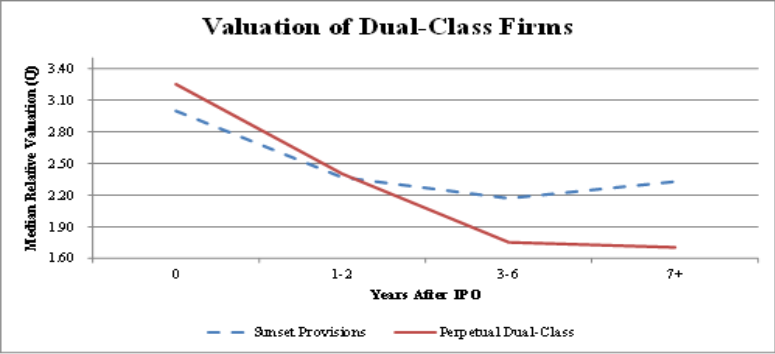
Source: Robert Jackson, US Securities and Exchange Commission, 2018
From this body of research we believe there are strong theoretical and empirical foundations that demonstrate the risks that dual class shares bring to minority investors. Though much of this research was based in the US, we believe it also has relevance in other markets globally, including Singapore. While the risks of dual class structures can ultimately be priced into a company’s valuation or mitigated through structural features that are being proposed in the CP, we believe the most sensible starting point is simply to avoid the introduction of dual class share regimes in the first place. Otherwise we believe there is a slippery slope to unintended consequences, even with the best of intentions.
We would like to express these fundamental objections before responding to the more granular nature of the individual consultation questions. We acknowledge that many of the protections proposed in the CP will be welcome if this dual class regime is to be implemented. However we do not believe these will necessarily mitigate the related risks.
Consultation Questions:
- Definition. We agree with the definitions.
- Suitability requirement. If dual class shares are to be introduced we agree that the issuer should be “suitable” for listing. The problem, however, is that the assessment of suitability is potentially vague and subjective. Suitability might also be something that can change with time, and suggests that if a suitability requirement is in place it must also be monitored on an ongoing basis.
- Moratorium. We support a 12 month moratorium for holders of MV shares on the transfer or disposal of their shareholding.
- Maximum voting differential. 10 votes per MV share is too high, and should lead to a more rapid and less reversible entrenchment of insiders– and to the disenfranchisement of minority shareholders. The issuer should not be allowed to raise the votes per MV share post listing, but could be allowed to reduce this ratio. We would note that the Florange Act in France (a law that we oppose) provides for double voting rights rather than a multiple of 10 times. If you are to have dual class shares 2x would be a more sensible multiple.
- Rights of OV shareholders. The proposed minimum 10% threshold for total voting control by OV shareholders is way too low, and offers little possibility for minority shareholders to have a meaningful voice. A 25% threshold, consistent with free float norms in other global markets, would be more meaningful in terms of minority protections. We would support a 10% threshold for shareholders to convene a general meeting.
- Restriction on issuance of MV share post listing. We do not think an issuer should be able to issue MV shares post listing under any scenario. If there were to be such an issue it should be approved by shareholders at a general meeting, and there should be some form of an “enhanced voting process”– either a supermajority provision or a “majority of the minority” provision — to allow minority shareholders to have a voice in such capital raisings.
- Automatic conversion of MV shares. We recognise that the automatic conversion process is a form of sunset provision, so we welcome this protection, and agree that the holder of the MV shares should be required to abstain from voting on any resolution to waive the conversion. We think it would be preferable not to allow waivers in the first place, but if they are allowed it should be under the Enhanced Voting Process. We believe there may also be merit in a “contingent conversion” requirement, which could be triggered by defined actions or events that might give rise to questions about the issuer’s “suitability” for dual class share issuance.
- Independence element on board committees. We agree that all three committees should be independent. Our Global Governance Principles call for 100% independence in audit and remuneration committees.
- Reserved matters under the Enhanced Voting Process. We agree that the matters listed in paragraph 2.2 of Part IV of the consultation should require the Enhance Voting Process. These are important issues, and enhanced voting should enhance minority shareholder protections. Additional considerations that might be added to this include:
- Approval of capital issuance/repurchase authorities
- The schemes of arrangement or reconstruction
- Any matters requiring the passing of a special resolution
- Any instances where shareholder approval is required under the Listing Rules for “connected transactions” and substantial acquisitions/disposals and other material transactions.
- Disclosure of the rights of shareholders. We support the disclosure requirements that are being proposed.
In conclusion, ICGN opposes the introduction of a dual class share framework in Singapore. We believe this works against the interests of institutional investors and minority shareholder rights – and in turn has the potential to affect investor perceptions negatively about the governance standards and minority protections in Singapore. We would rather encourage the leading global stock exchanges, of which SGX is certainly one, to show greater collective leadership in avoiding the introduction of dual class shares, rather than focus on how to mitigate risks related from these structures. Having said that, if a dual class framework is introduced we believe many of the protections proposed are welcome, and should help to support minority shareholder rights.
We hope that our feedback and comments are helpful in your deliberations. Should you wish to discuss our comments further, please contact me or George Dallas, ICGN’s Policy Director, by email at george.dallas@icgn.org.
Yours faithfully,
Kerrie Waring,
Chief Executive Officer, ICGN
Copies:
Eugenia Unanyants-Jackson, Co-Chairman, ICGN Shareholder Rights Committee: Eugenia.Jackson@AllianzGI.com
Bram Hendriks, Co-Chairman, ICGN Shareholder Rights Committee, BHendriks@ktmc.com