
MSCI Equity Index Committee
7 World Trade Center
250 Greenwich Street
New York, NY 10007
By email: clientservice@msci.com
31 May 2018
ICGN Comment on the Treatment of Unequal Voting Structures in the MSCI Equity Indices
The International Corporate Governance Network (ICGN) is pleased to respond to the MSCI’s Consultation on the Treatment of Unequal Voting Structures in the MSCI Equity Indices.
Led by investors responsible for assets under management in excess of US$34 trillion, ICGN is a leading authority on global standards of corporate governance and investor stewardship. Our membership is based in more than 45 countries and includes companies, advisors and other stakeholders. ICGN’s mission is to promote high standards of professionalism in governance for investors and companies alike in their mutual pursuit of long-term value creation contributing to sustainable economies world-wide. Our policy positions are guided by the ICGN Global Governance Principles and the ICGN Global Stewardship Principles, both of which have been developed in consultation with ICGN Members and as part of a wider peer review. For more information on ICGN please see: www.icgn.org
ICGN has been actively involved in the global debate with regulators, exchanges and index providers with regard to the broad issue of differential ownership structures and the more specific question of the inclusion of dual class share structures in major benchmark indices. This includes our response to MSCI’s 2017 consultation, as well as to recent consultations by S&P Dow Jones and FTSE/Russell.1 Simply put, we (and the vast majority of ICGN members) oppose differential structures in the first place, as we believe these stand to erode management and accountability to minority shareholders by watering down their rights and can also marginalise the investor voice though the exercise of voting rights.
We are aware of arguments suggesting that policy makers, not index providers, should set corporate governance standards. In principle, we agree with this, assuming public policy is robust. However in cases where public policy may lead to a lower common denominator, such as in the case of dual class shares, investors – as owners of listed securities– will not want to rely on a weak regulatory standard or a lower common denominator. Therefore, in the absence of a stronger regulatory position on dual class shares we think it is entirely appropriate that index providers listen to the preferences and needs of their investor customers who make use of these indices for portfolio construction.
We present in greater detail below our position on differential ownership and our interpretation of the leading research, but we would like to start by congratulating MSCI on its thoughtful approach to this consultation and its clear effort to gather a wide range of views from market participants. We appreciate that MSCI has had to balance conflicting perspectives and pressures on this issue. While we think a more aspirational approach might have gone further than what you propose, we do recognise the pragmatic realities that you are trying to balance, and are supportive of your approach to the treatment of unequal voting structures.
A more “purist” approach might call for complete ban on any form of dual class share in a benchmark index, but we recognise the practical complexities of such an approach given the existing universe of companies with dual class shares in markets around the world. However, we would hope that index inclusion might come to serve as a positive motivation for companies to consider modifying their governance frameworks to eliminate, at least over time, dual class share structures. In this context we support the suggestion made to you by the Council of Institutional Investors to provide some form of “exemptive relief” from this voting rights mechanism for those new IPOs or existing issuers that agree to a sunset structure within a reasonable time frame.
Dual class share structures: ICGN position
Our response to this consultation on unequal voting shares builds from our 2017 submission to MCSI. We have presented similar views presented in recent consultations on dual class share structures in both Hong Kong2 and Singapore.3 ICGN also expressed its views in two Viewpoint reports in 2017.4 Our message is consistent, whether it is in Singapore, Hong Kong or any other public capital market: ICGN and its members are fundamentally opposed to dual class share structures and the separation of economic ownership and voting control. We believe these structures are fundamentally flawed and carry significant governance risks for minority shareholders by diluting minority shareholder protections, management entrenchment and limited accountability. In extremis such structures create opportunities for expropriation, with controlling shareholder gaining private benefits of control at the expense of minority shareholders.
We are concerned in particular that we are witnessing a “race to the bottom” by major global stock exchanges seeking to attract listings by watering down governance safeguards. Exchanges may conclude that the benefits of a dual class share regime offset the potential risks and costs. We would observe, however, that the distribution of benefits and costs in this situation is asymmetrical – the issuer community and the exchanges themselves would be the main winners, with minority shareholders as the main losers.
Our earlier submissions have cited the results of 2017 ICGN membership poll in which 84% of ICGN members disapproved of differential voting right structures and 67% believed that differential voting structures would impact negatively stock valuations.
The MSCI consultation paper of January 2018 does a good job of presenting the case both for and against unequal voting rights. However, while we appreciate the logic of both sides of this argument we have found more compelling academic evidence and research that frame dual class shares as more of a potential problem than a solution.
While controlling owners might enjoy private benefits of dual class control arrangements our concern is that minority shareholders may be the net losers in differential ownership arrangements:
- A recent research literature review of differential ownership by Stanford University academics Larcker and Tayan concludes “the evidence suggests that companies with dual-class structures tend to have lower governance quality”.5
- In an empirical study of dual class structures in the United States, the study’s authors (Gompers, Ischii and Metrick of Harvard, Stanford and Yale, respectively) concluded “we find that firm value is positively associated with insiders’ cash-flow rights, negatively associated with insiders’ voting rights, and negatively associated with the wedge between the two.” The authors go on to say that “a majority owner of a private company can rationally choose to sacrifice some firm value in order to maintain private benefits of control.” That may be well and good for the controlling owner. But it also suggests that these private benefits come at a cost to minority investors.6
- A study of dual class share structures by Harvard Law School academics (Bebchuk and Kastiel) outlines the risks of entrenchment, self-dealing and perverse incentives that come with dual class shares, noting that there is an “untenable” case for perpetual dual class shares. They state that “as time passes the potential costs of a dual class structure ten to increase and the benefits tend to erode.” The authors propose a requirement for sunset provisions in cases where such structures exist.7
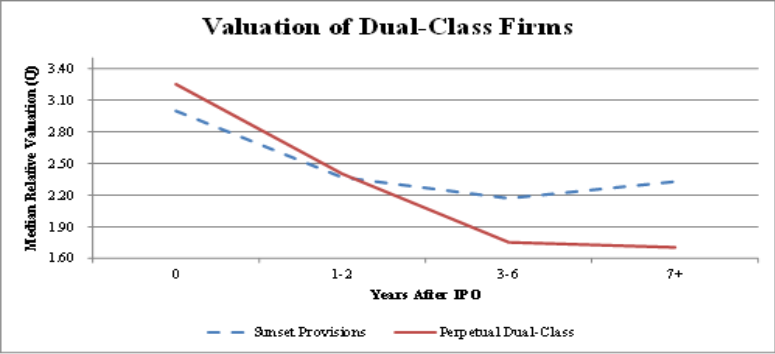
- Robert Jackson, a former Columbia Law School Professor, and currently a Commissioner at the US Securities and Exchange commission also recently articulated similar reservations about dual class share structures. Like Bebchuk and Kastiel he is not an advocate of dual class shares, and also supports the use of sunset provisions in cases where they exist. His own research suggests that if there is an advantage to dual class structures, such structures should not be permanent as they can lead to value deterioration over time.8 The following graph makes this point clear:
Source: Robert Jackson, US Securities and Exchange Commission, 2018
- A 2017 research paper by Andrew Winden of Stanford’s Rock Center for Corporate Governance presents a somewhat more sympathetic view of dual class shares, including an empirical analysis of 123 US public companies with dual class structures.9 This analysis observes that dual class shares can enable young and entrepreneurial businesses to develop and build sustainable value, but the paper also acknowledges that, at least over time, dual class structures can also create significant incentives for entrenched management owners to seek private benefits of control, misappropriating or destroying corporate value in the process. Winden suggests that these risks can be mitigated with an appropriate mix of “sunrise” provisions (governance arrangements while differential rights in place) and “sunset” provisions which lead to the end of differential rights over time.
From this body of research and evidence we believe there are strong theoretical and empirical foundations that demonstrate the risks that dual class shares bring to minority investors. Though much of this research was based in the US, we believe it also has relevance in other markets globally. While the risks of dual class structures can ultimately be priced into a company’s valuation or mitigated through structural features, we believe the most sensible starting point is simply to avoid the introduction of dual class share regimes in the first place. Otherwise we believe there is a slippery slope to unintended consequences, even with the best of intentions.
However, we recognise the reality that some young companies may wish to be listed with a dual class structure, at least to provide a nurturing environment buffered from potentially short term market forces. The graph presented above by Robert Jackson suggests that there may be an initial period of time in which dual class companies may benefit from this structure. But in our view the weight of evidence suggests that if dual class structures are to be employed there should also be the intent to change structures when appropriate, ideally in the form of a reasonable sunset timeframe. This is why we would like MSCI to consider linking sunset arrangements more clearly into their approach.
From this policy foundation we respond to the specific questions in the consultation:
Treatment of unequal structures:
- Do you agree that unequal voting shares should remain eligible for index inclusion? In principle ICGN is opposed to unequal voting shares being eligible for index inclusion for the reasons outlined above.
- Do you agree that the index weight of securities with unequal voting structures should be linked to voting power? If dual class shares are to be introduced at all, we think the proposed approach by MSCI presents a pragmatic way to balance the differing perspectives of issuers and investors.
- Is it appropriate to delete securities with zero company voting power from the MSCI indices. Yes, we support this.
Voting power adjustment
- Is the application of a voting power adjustment an appropriate way to reflect misalignment between voting power and economic interest? We believe it is a clever mechanism that will probably serve this purpose as well as or better than any other solution that we are aware of.
- Is the method for calculating the adjustment adequate? We do not have further suggestions relating to the calculation method, however as noted in question 7 below we do have objections relating to the proposed exceptions.
- Do you agree that the votes per share should be zero in cases where voting rights are restricted? (page 10) Yes, we support this position.
- Do you agree with the proposed exceptions? (page 10). We object to exception where a share class imposes partial restrictions on the election of directors. We believe this could result in unintended consequences, and support the position articulated by the Council of Institutional Investors on this point. We also do not understand, or agree with, why loyalty shares would not be considered in this calculation.
Implementation
- Is it appropriate to grant a grace period for current constituents? Yes, we support a grace period for current constituents – for the benefit of both issuers and investors.
- Is a three-year grace period sufficient or should more time be given? In addition to a three year grace period we would encourage the introduction of some form of exemption for issuers (both new and existing companies) implementing some form of time-based sunset provision.
- Are the proposed index maintenance rules for the Vote Adjusted Security Free Float appropriate? They appear to be appropriate and we have no further suggestions.
- Should MSCI implement the changes for current index constituents in one step or would a multiple step transition be appropriate? We see potential benefits with both approaches, but we recognise that a multiple step transition may be less disruptive for many investors in making portfolio adjustments.
In conclusion, ICGN opposes the introduction of a dual class share framework in markets generally. We believe this works against the interests of institutional investors and minority shareholder rights. We would rather encourage the leading global stock exchanges to show greater collective leadership in avoiding the introduction of dual class shares, rather than focus on how to mitigate risks related from these structures. However, for purposes of this consultation ICGN supports the pragmatic direction that MSCI is taking with its voting rights approach. But we encourage MSCI to take one step further through linking sunset provisions to this process to incentivise companies eliminating dual class structures at the appropriate point in the company’s life cycle.
We hope that our feedback and comments are helpful in your deliberations. Should you wish to discuss our comments further, please contact me or George Dallas, ICGN’s Policy Director, by email at george.dallas@icgn.org.
Yours faithfully,
Kerrie Waring
Chief Executive Officer, ICGN
Copies:
Eugenia Unanyants-Jackson, Co-Chairman, ICGN Shareholder Rights Committee: Eugenia.Jackson@AllianzGI.com
Bram Hendriks, Co-Chairman, ICGN Shareholder Rights Committee, BHendriks@ktmc.com